Back to blog
Property Management24 June 202615 min read

New Rent Agreement Rules in India (2025–2026): Complete Guide for Landlords & Tenants

A current guide to rent agreements in India covering the Model Tenancy Act, registration, deposits, tenant rights, landlord duties, eviction, and compliance.

Shilpi Shukla

Written by

Shilpi Shukla

Read time

15 min read

Posted on

24 June 2026

New Rent Agreement Rules in India (2025–2026): Complete Guide for Landlords & Tenants

Last reviewed: 24 June 2026

Renting a house, apartment, PG room, hostel bed, or commercial property in India depends on clear documentation and the law applicable where the property is located. Written agreements, digital payment records, tenant verification, and documented maintenance responsibilities can reduce disputes for both landlords and tenants.

However, there is an important legal point behind searches for “new rent agreement rules in India 2025–2026”: India does not have one new nationwide tenancy law that automatically replaces every state law. The Union Cabinet approved the Model Tenancy Act, 2021 as a model framework for states and Union Territories. Land and tenancy are state subjects, so adoption, amendments, procedures, and enforcement vary by jurisdiction.

This guide explains the current practical framework, the Model Tenancy Act’s key proposals, rent-agreement registration, security deposits, rent increases, maintenance, privacy, eviction, police verification, tax records, and dispute resolution. It is general information, not legal or tax advice. Check the current law, stamp duty, registration process, and local rules for the state and city where the property is situated.

Quick Answer: What Changed in 2025–2026?

There is no single central “Rent Agreement Rules 2025” or “Rent Agreement Rules 2026” law that applies uniformly to every tenancy in India.

The practical position is:

  • The Model Tenancy Act, 2021 remains a model framework rather than an automatically applicable nationwide tenancy code.
  • State rent-control laws, tenancy laws, rules, notifications, and local procedures remain decisive.
  • The Registration Act, 1908 and applicable state stamp law affect execution, stamping, and registration of lease documents.
  • Security-deposit caps of two months for residential premises and six months for non-residential premises come from the Model Tenancy Act framework; they should not be presented as a universal cap unless adopted in the relevant jurisdiction.
  • Digital rent payment is useful evidence and good practice, but it is not universally mandatory for every private tenancy.
  • Police or tenant verification requirements vary by state, city, and local police procedure.

What Is the Model Tenancy Act?

The Government of India approved the Model Tenancy Act in 2021 to provide states and Union Territories with a modern framework for rental housing. Its goals include encouraging formal rental housing, balancing landlord and tenant interests, promoting written agreements, and creating faster institutional dispute resolution.

The framework covers concepts such as:

  • Written tenancy agreements
  • Information to a Rent Authority
  • Rights and obligations of landlords and tenants
  • Security deposits
  • Rent revision
  • Entry into rented premises
  • Essential services
  • Property maintenance
  • Eviction and recovery of possession
  • Rent Courts and Rent Tribunals

Because it is a model law, landlords and tenants must verify whether their state has adopted similar provisions and what local procedures currently apply.

Why Written Rent Agreements Matter

A verbal arrangement can be difficult to prove when parties disagree about rent, deposit, repairs, notice, or possession. A written agreement creates a common record of what both parties accepted.

A practical rent agreement should identify:

  • The landlord and tenant
  • The complete property address and rented portion
  • Permitted residential or commercial use
  • Start date and tenancy duration
  • Monthly rent and due date
  • Security deposit and refund process
  • Maintenance and utility charges
  • Rent-escalation clause
  • Lock-in period, if any
  • Notice and renewal terms
  • Repair and maintenance responsibilities
  • Entry and inspection procedure
  • Subletting or assignment restrictions
  • Rules for pets, parking, common areas, and society compliance
  • Move-in inventory and property condition
  • Default, termination, and dispute-resolution terms

Names, addresses, identity details, property description, dates, and payment amounts should be checked carefully before signing.

Registration and Stamping of Rent Agreements

Stamping and registration are related but separate legal requirements.

Under the central Registration Act, leases from year to year, leases for a term exceeding one year, and leases reserving yearly rent are among documents that require compulsory registration. Shorter arrangements are often treated differently under the central Act, but state amendments, stamp laws, local practice, and the document’s actual terms can change the position.

Do not assume that every “11-month agreement” is automatically compliant merely because of its duration. Parties should verify:

  • Applicable stamp duty
  • Whether e-stamping is available
  • Whether registration is compulsory or advisable
  • Required witnesses and identity documents
  • Local sub-registrar procedures
  • Whether online submission or biometric appearance is required
  • Whether the state has a Rent Authority filing process

Proper stamping and registration can improve evidentiary value and prevent avoidable disputes. The Model Tenancy Act’s concept of informing a Rent Authority should also not be confused with registration under the Registration Act.

Security Deposit Rules

The Model Tenancy Act framework proposes a maximum security deposit of:

  • Two months’ rent for residential premises
  • Six months’ rent for non-residential premises

These figures are frequently described online as nationwide “new security deposit rules.” That description is incomplete. The limits apply as law only where the relevant jurisdiction has adopted and implemented equivalent provisions.

Regardless of the local cap, the agreement should state:

  • Deposit amount and payment date
  • Purpose of the deposit
  • Whether it can be adjusted against rent
  • Permitted deductions
  • Inspection and handover process
  • Evidence required for damage deductions
  • Refund timeline under the applicable agreement and law
  • Bank details or payment method for refund

Landlords should not treat ordinary wear and tear as tenant damage. Tenants should keep the deposit receipt, move-in photographs, inventory, and handover record.

Digital Rent Payments and Receipts

UPI, bank transfer, net banking, cards, and other digital methods create a traceable payment history. Digital payment is good operational practice, but parties should not describe it as universally mandatory unless a specific law or contractual requirement applies.

For every payment, maintain:

  • Tenant and property name
  • Rental period
  • Rent amount
  • Maintenance or utility components
  • Payment date and mode
  • Transaction reference
  • Receipt number
  • Outstanding balance, if any

Cash payments should also be supported by a signed or digital receipt. A payment screenshot alone may not explain which month or charge was settled.

Rent Increase Guidelines

Rent revision should follow the agreement and applicable state law. A well-drafted escalation clause states the frequency, percentage or calculation method, effective date, and notice process.

Best practices include:

  • Put the increase formula in the agreement
  • Give written notice before the revised rent begins
  • Avoid retrospective or unexplained increases
  • Record the tenant’s acknowledgement
  • Issue updated bills and receipts
  • Execute renewal or amendment documents where required

If a state rent-control law restricts increases for a particular category of premises, that law may override the parties’ preferred arrangement.

Maintenance Responsibilities

Maintenance is a common source of rental disputes. Responsibilities should be allocated in the agreement rather than decided only after a problem occurs.

Common Tenant Responsibilities

  • Routine cleanliness
  • Replacing consumables such as bulbs
  • Minor day-to-day upkeep agreed in the contract
  • Reporting leaks, electrical faults, or damage promptly
  • Using fixtures and appliances carefully
  • Paying tenant-specific utility consumption

Common Landlord Responsibilities

  • Structural repairs
  • Major plumbing or electrical faults not caused by misuse
  • Roof or external seepage
  • Building-safety issues
  • Repairs to provided systems and fixtures, subject to the agreement
  • Compliance relating to ownership and common infrastructure

The actual allocation depends on the agreement and applicable law. A dated complaint and repair log helps establish what was reported, assigned, paid, and resolved.

Tenant Privacy and Landlord Entry

A rented property is the tenant’s home or place of business during the tenancy. Landlords should not enter casually or use duplicate keys without a legitimate reason and appropriate notice, except in genuine emergencies.

The agreement should define:

  • Permitted reasons for entry
  • Notice method
  • Reasonable visiting hours
  • Emergency access
  • Inspection frequency
  • Access for repairs or prospective tenants near move-out

The Model Tenancy Act includes a notice-based approach to entry, but local law and the signed agreement must be checked.

Essential Services

Electricity, water, sanitation, and other essential services should not be disconnected as a pressure tactic. Disputes over rent or possession should be handled through lawful procedures.

Both parties should retain bills, notices, meter readings, and complaint records. If an essential service is interrupted, obtain advice based on the applicable state law and the facts of the case.

Eviction and Recovery of Possession

A landlord cannot lawfully replace due process with force. Lockouts, harassment, removal of belongings, or deliberate disconnection of essential services can create serious legal consequences.

Eviction or recovery of possession may depend on grounds recognized by the applicable law and agreement, such as:

  • Non-payment of rent
  • Unauthorized subletting
  • Misuse of premises
  • Material breach of the agreement
  • Structural alteration or damage
  • Expiry or valid termination of tenancy
  • Landlord’s bona fide requirement where recognized

The correct notice, forum, evidence, and procedure vary by jurisdiction. Landlords should obtain local legal advice before initiating eviction. Tenants should respond to formal notices within the required period and preserve payment and communication records.

Tenant Police Verification

Police verification and tenant-information procedures vary across India. Some local authorities require or actively expect landlords to submit tenant details; others provide online or offline verification facilities.

Landlords should check the official website or police station for the property’s locality. A verification file may include:

  • Tenant identity and address proof
  • Photograph
  • Permanent address
  • Emergency contact
  • Employment or educational information where relevant
  • Signed agreement
  • Local verification form and acknowledgement

Police verification does not replace KYC, a rent agreement, or lawful data-protection practices.

Tax and TDS Records

Rental income and rent payments can have income-tax and TDS consequences depending on the payer, payee, property use, rent amount, and applicable provision.

Maintain records of:

  • Rent received or paid
  • Deposit received and refunded
  • Maintenance and utility charges
  • TDS certificates and challans, where applicable
  • Property taxes
  • Repairs and eligible expenses
  • Rent receipts and bank statements

Tax thresholds and rates can change. Landlords and tenants should verify the current Income Tax Department guidance and consult a qualified tax professional for their specific situation.

Create and manage rental records digitally

Organize tenant KYC, rent agreements, deposits, payments, receipts, reminders, and property operations with RentTenant.

Rent Authorities, Rent Courts, and Tribunals

The Model Tenancy Act proposes a three-level structure involving Rent Authorities, Rent Courts, and Rent Tribunals. The intention is specialized and faster resolution of disputes involving rent, deposits, possession, maintenance, and tenancy obligations.

Availability and procedure depend on state adoption and notification. Before filing a case, identify the authority that actually has jurisdiction over the property and dispute.

Landlord Compliance Checklist

  • Verify ownership and authority to rent the premises
  • Use a written, correctly stamped agreement
  • Register or file the agreement where required
  • Complete local tenant or police verification
  • Record KYC with appropriate security and access controls
  • Issue receipts for rent and deposits
  • Define deposit deductions and refund procedure
  • Document property condition at move-in and move-out
  • Maintain rent, utility, repair, and communication records
  • Give written notices under the agreement and applicable law
  • Never use force or disconnect essential services to secure eviction
  • Review state-specific rules before renewal or rent revision

Tenant Checklist Before Signing

  • Verify the landlord’s identity and authority
  • Inspect the property and create a photo inventory
  • Read rent, deposit, escalation, lock-in, and notice clauses
  • Confirm maintenance and utility charges
  • Understand society, parking, guest, pet, and common-area rules
  • Check stamping and registration requirements
  • Obtain receipts for every payment
  • Keep a signed copy of the agreement and annexures
  • Record meter readings and keys at handover
  • Do not sign blank pages or rely only on verbal promises

How RentTenant Helps

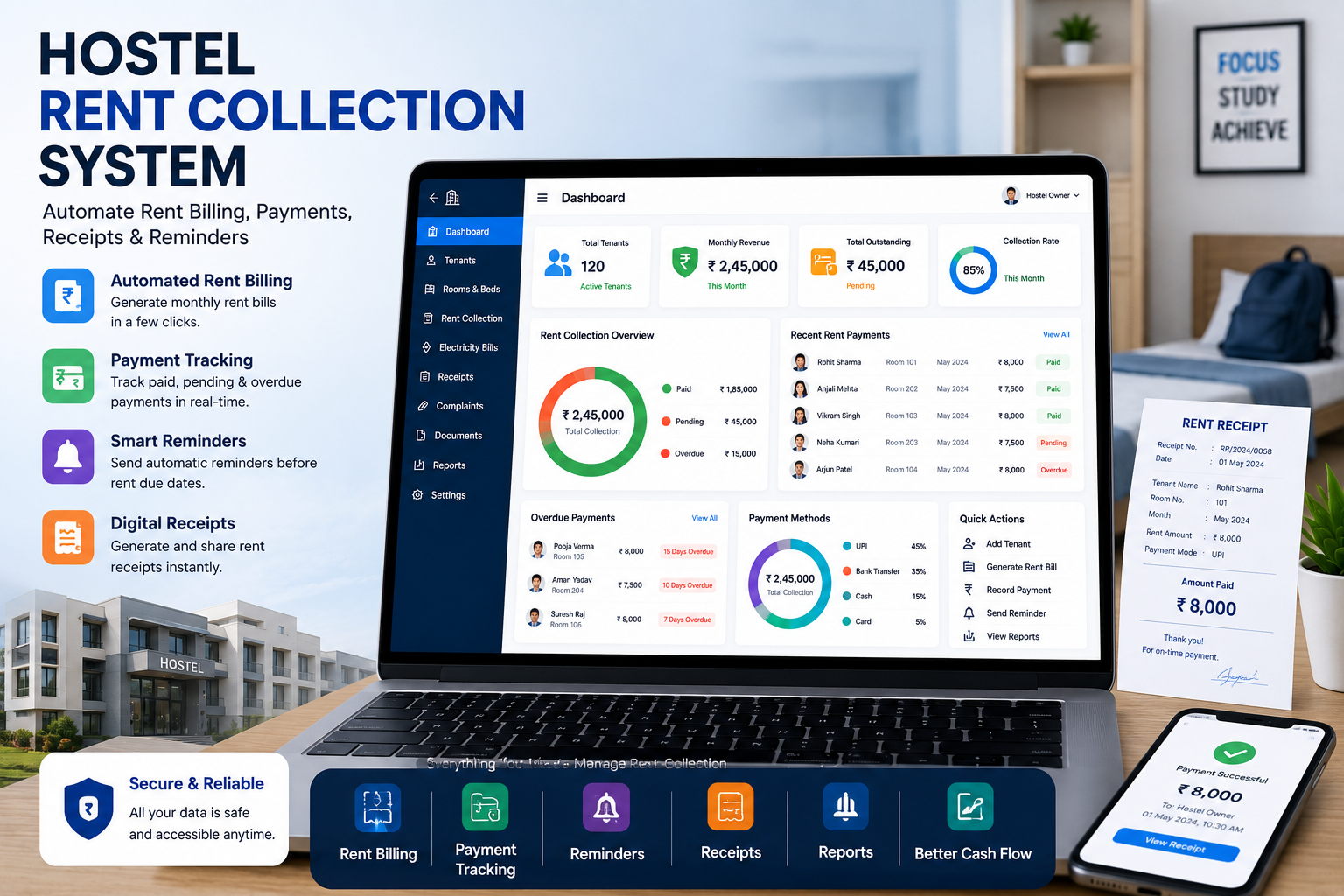
RentTenant helps landlords, hostel owners, PG operators, and rental-property managers keep operational records organized from one dashboard.

Features include:

  • Tenant and property management
  • Room and bed allocation
  • Rent tracking and digital receipts
  • Security-deposit records
  • Electricity billing
  • Tenant eKYC
  • Rent agreement generator
  • Deposit receipt generator
  • Complaint and maintenance tracking
  • WhatsApp and email reminders
  • Visitor management
  • Multi-property reporting
  • Expense management and analytics

Software can improve documentation and workflows, but it does not replace state-specific legal advice, registration, stamp duty, or statutory compliance.

Conclusion

The most important rent-agreement rule for 2025–2026 is to avoid treating a national model framework as if it were automatically the law in every state. Use a clear written agreement, verify local stamping and registration requirements, document deposits and rent payments, respect privacy, define maintenance, and follow lawful dispute and eviction procedures.

Digital tools such as RentTenant can make agreements, receipts, tenant records, reminders, and property operations easier to manage. Legal enforceability still depends on the applicable law, facts, and correctly completed formalities.

This article provides general educational information reviewed on 24 June 2026. It is not a substitute for advice from a lawyer, chartered accountant, or the competent authority in the property’s state.

Frequently Asked Questions

Is the Model Tenancy Act applicable across India?

No. It is a model framework for states and Union Territories. Its provisions apply as law only through the relevant state or Union Territory’s adoption and implementation. Check the current local law for the property.

Is a written rent agreement necessary?

A written agreement is strongly recommended and may be required under the applicable framework. It creates evidence of rent, deposit, duration, responsibilities, notice, and other agreed terms.

Does every 11-month rent agreement avoid registration?

Not automatically. The Registration Act, state amendments, stamp law, document terms, and local procedures must be considered. Verify the requirement for the property’s jurisdiction.

Can a landlord ask for an unlimited security deposit?

The Model Tenancy Act framework proposes caps of two months’ rent for residential premises and six months’ rent for non-residential premises. Whether those caps are legally applicable depends on adoption in the relevant jurisdiction and other applicable law.

Are digital rent payments mandatory?

Not universally. Digital payments are recommended because they create a transparent record. Any mandatory requirement would need to come from applicable law, regulation, or the agreement.

Can a landlord enter the rented property at any time?

Landlords should respect tenant privacy and follow the notice and access terms in the agreement and applicable law, except where a genuine emergency justifies immediate access.

Is tenant police verification compulsory?

Requirements vary by state, city, and local police authority. Check the official local procedure for the property’s address.

Can a landlord evict a tenant by changing the locks?

Landlords should not use force, lockouts, harassment, or service disconnection. Eviction and recovery of possession must follow the applicable legal process.

How can RentTenant help landlords?

RentTenant organizes tenant records, digital agreements, rent and deposit tracking, receipts, electricity billing, reminders, eKYC, complaints, and multi-property operations in one system.

rent agreementrent agreement rules IndiaModel Tenancy Actlandlord rightstenant rightssecurity depositrental propertyRentTenant
Shilpi Shukla

About the Author

Shilpi Shukla

Shilpi Shukla has 7 years of experience in rental property, hostel, PG, and tenant management. She shares practical insights to help property owners simplify operations, improve tenant experiences, and grow their rental business with RentTenant.

You may also like these

Related Articles

Newsletter

Stay ahead in rental management with expert insights

Get practical ideas for tenant onboarding, billing, reminders, and property operations.