GST on PG Rent: What Every Owner Must Know in 2026
A complete 2026 guide to GST applicability on PG, hostel, and co-living rentals in India. Learn exemption thresholds, 12% vs 18% tax rates, RCM rules, and GST-compliant invoicing.
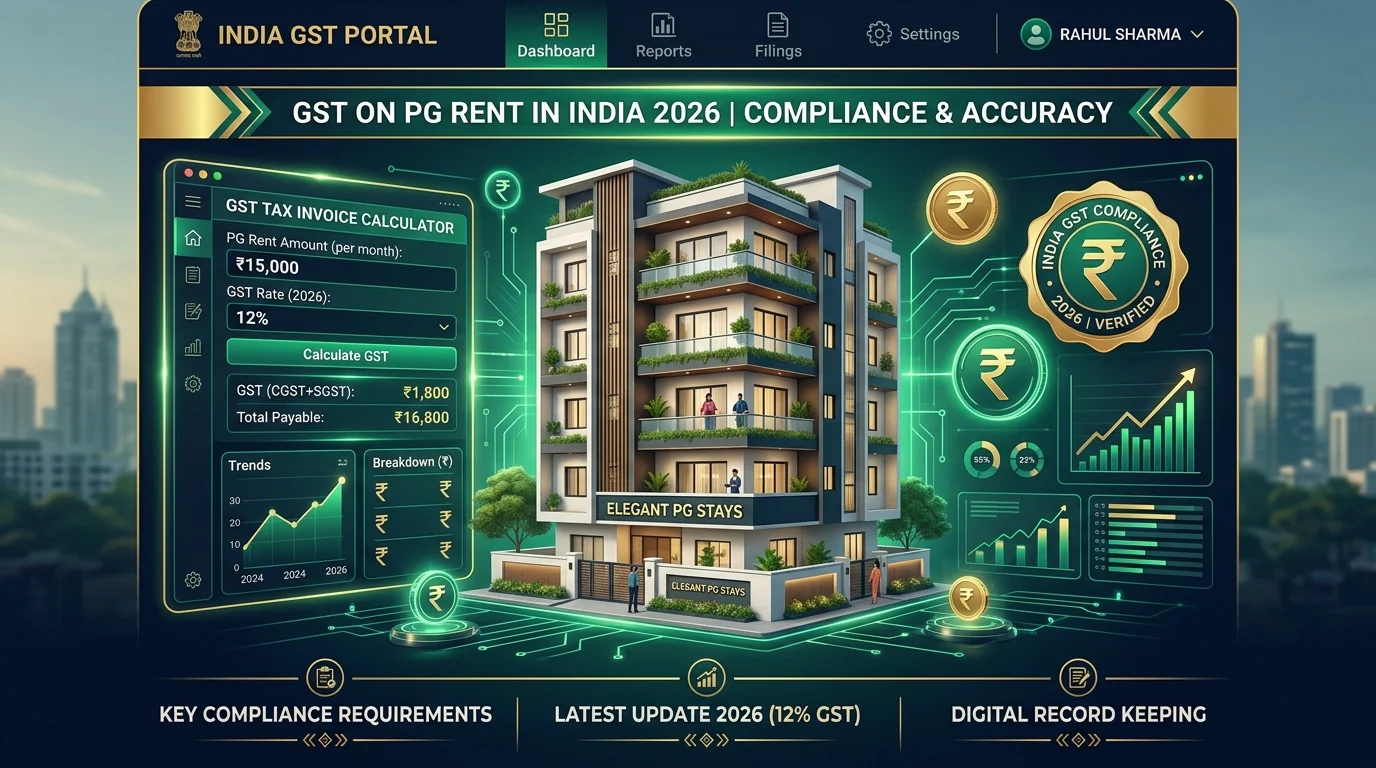
GST on PG Rent: What Every Owner Must Know in 2026
The Goods and Services Tax (GST) landscape for residential renting, PG (Paying Guest) accommodations, and hostels in India has undergone significant evolution following recent GST Council clarifications and AAR (Authority for Advance Rulings) decisions.
For property owners, co-living operators, and hostel managers, understanding whether GST applies to your rental revenue is critical. Misinterpreting GST applicability can lead to hefty penalties, tax demand notices, and operational disruption.
This comprehensive guide breaks down the latest GST rules, exemption limits, applicable tax rates, and compliance requirements for PG and hostel owners in 2026 in simple, plain English.
The Core Rule: Residential Dwelling vs. Commercial PG Services
To determine your GST liability, Indian tax laws distinguish between renting a residential dwelling for residence versus providing commercial hostel/PG services:
| Parameters | Residential Property Renting | PG / Hostel / Co-Living Business |
|---|---|---|
| Primary Nature | Renting an apartment/house to a family for living | Commercial lodging bundled with food, WiFi, & housekeeping |
| GST Applicability (Unregistered Tenant) | Exempt from GST | Taxable if annual turnover exceeds threshold |
| GST Applicability (Registered Business Tenant) | Taxable under Reverse Charge Mechanism (RCM) @ 18% | Taxable @ 12% or 18% under SAC 9963 / 9972 |
| Threshold Exemption | N/A (Exempt by notification) | ₹20 Lakhs (Services) / ₹40 Lakhs in specified cases |
| SAC Code | 997211 | 996311 (Room lodging) or 996331 (Mess/Canteen) |
1. GST Exemption Limits & Registration Thresholds in 2026
If you operate a PG or hostel business in India, you are classified as a service provider under GST laws. You are legally required to register for GST only if your aggregate annual turnover exceeds specified thresholds:
- General States Threshold: ₹20 Lakhs per year for supply of services.
- Special Category States Threshold: ₹10 Lakhs per year (in states like Manipur, Mizoram, Nagaland, and Tripura).
- Aggregate Turnover Calculation: Includes rental income from all properties owned under the same PAN card, mess charges, maintenance fees, and utility re-bills across India.
If your total annual revenue across all PG buildings is below ₹20 Lakhs, you are exempt from registering for GST and collecting tax from tenants.
2. Applicable GST Rates on PG & Hostel Accommodations
Following the withdrawal of the ₹1,000 per day exemption for hotel rooms, GST rates for PG and hostel services are categorized based on service bundling:
A. Room Lodging Only (12% GST)
- SAC Code: 996311 / 997212
- Rate: 12% GST (6% CGST + 6% SGST) without Input Tax Credit (ITC) benefits on long-term residential stays exceeding 90 continuous days.
Automate GST-Compliant Rent Invoicing & Receipts
Stop stressing over GST calculations, manual receipts, and tax audits. Generate GST-compliant rent receipts, track utility sub-meters, and collect rent online with RentTenant.
B. Bundled Services (Mess, WiFi, Housekeeping @ 12% or 18%)
- When room stay is bundled with mess facilities, air conditioning, and laundry as a single consolidated package:
- Composite Supply Rate: Generally taxed at 12% if classified under accommodation services.
- Input Tax Credit (ITC): If the owner opts for the 18% tax slab with ITC, they can claim credit on GST paid for commercial furniture, AC units, and security systems.
For complete income tax deductions beyond GST, refer to our comprehensive India property & rental tax guide.
3. The 90-Day Continuous Stay Exemption Rule
Following recent GST Council clarifications aimed at protecting long-term students and working professionals, an exemption applies to extended stays:
- The Rule: Accommodation provided in hostels, PGs, or co-living spaces for a continuous period of at least 90 days (3 months) to an individual is treated as equivalent to residential renting and is exempt from GST.
- Key Condition: The tenant must possess a valid 11-month rental agreement or stay contract. Transient stays lasting less than 90 days remain fully subject to GST.
4. Reverse Charge Mechanism (RCM) on Property Leases
Many PG operators do not own the building; instead, they take an entire property on lease from a landlord and sub-let beds to students and IT professionals.
- Landlord is Unregistered, Operator is GST-Registered: The GST-registered PG operator must pay 18% GST under Reverse Charge Mechanism (RCM) on the lease rent paid to the landlord.
- Landlord is GST-Registered: The landlord bills 18% GST directly on the commercial rent invoice.
To ensure your tenancy contracts account for RCM clauses properly, check our guide on security deposit laws and tenant rights.
5. Checklist for GST Compliance for PG Owners
To maintain audit-ready financial records and avoid tax disputes, follow this 4-step compliance checklist:
- Issue GST-Compliant Tax Invoices: Provide itemized invoices separating room rent from mess and utility charges. Use an online rent receipt generator to issue valid GST receipts.
- Collect Aadhaar & KYC: Validate tenant identities digitally before onboarding. Follow our 10-minute blueprint on how to onboard a new tenant in under 10 minutes.
- Separate Sub-Meter Utility Billing: Utility reimbursements on actual sub-meter readings are exempt from GST if billed as a pure agent. Learn how to eliminate utility leakage in our guide on how to track PG expenses digitally.
- File Monthly GSTR-1 & GSTR-3B Returns: File your monthly tax returns on time to pass on eligible Input Tax Credit to corporate clients.
Conclusion: Stay Compliant & Automate GST Invoicing
Navigating GST rules on PG rent in 2026 requires clear record-keeping, proper agreement structuring, and timely return filing. By keeping your turnover tracked and utilizing automated invoicing tools, you safeguard your business against legal notices and audits.
With RentTenant's hostel management software, property owners can automate GST rent receipts, track sub-meter utility billing, manage tenant ledgers, and streamline tax compliance effortlessly.
Looking to simplify your PG accounting? Explore RentTenant's tenant management software to issue instant WhatsApp receipts, manage digital KYC, and track rental ledgers today.

About the Author
Shilpi Shukla
Shilpi Shukla has 7 years of experience in rental property, hostel, PG, and tenant management. She shares practical insights to help property owners simplify operations, improve tenant experiences, and grow their rental business with RentTenant.