Property and Rental Tax in India: 2026-27 Guide
Understand capital gains, TDS, exemptions and rental income deductions for Indian property transactions in tax year 2026-27.

Selling or renting out real estate is one of the most significant financial transactions most individuals make . Whether you are dealing with a residential apartment, an investment plot, a commercial unit, or an inherited ancestral property, these transactions involve substantial capital and trigger major tax obligations under Indian tax laws .
Unfortunately, many property owners focus entirely on the gross sale price or monthly rent, overlooking the taxes that arise after the transaction is completed . This oversight frequently leads to unexpected tax liabilities, notices from the Income Tax Department, and missed opportunities to claim legal tax exemptions .
With the introduction of the new tax code and recent budget reforms, proactive tax planning is more critical than ever . This practical guide explains the latest property sale and rental tax rules in India for the Tax Year 2026–27 in simple, plain English—complete with worked calculations, legal tax-saving strategies, and compliance checklists .
The New Era: Transitioning to the Income Tax Act, 2025
For decades, direct taxation in India was governed by the landmark Income-tax Act, 1961 . However, effective 1 April 2026, the Indian government officially implemented the Income Tax Act, 2025, which completely supersedes its 65-year-old predecessor .
For landlords and property sellers, navigating this new era involves understanding two key structural changes—and one vital constant:
- "Tax Year" Replaces Old Terminology: The traditional concepts of "Previous Year" (the financial year in which income is earned) and "Assessment Year" (the subsequent year in which tax is filed) have been simplified . Starting 1 April 2026, income earned in the financial year 2026–27 is simply referred to as Tax Year 2026–27 .
- Renumbered Sections: The familiar sections of the 1961 Act have been renumbered and consolidated under the new Act . For example:
- Section 54 (reinvesting residential property gains) has been renumbered to Section 84 .
- Section 54EC (reinvesting in capital gains bonds) is now Section 85 .
- TDS on Property Transactions (formerly Section 194-IA for residents and Section 195 for non-residents) is consolidated under Section 393 .
- Non-Resident Remittance and repatriation procedures now fall under Section 395 .
- No Tax Rate Hikes: The transition is primarily a renumbering, cleanup, and administrative simplification . Every single tax rate, holding period threshold, exemption limit, and TDS rate carries over unchanged . If you sell a property on or after 1 April 2026, the tax you pay remains identical to the previous year; only the section references on your forms will differ .
STCG vs. LTCG: Classifying Capital Gains
When you sell property in India, you are taxed on the profit (the capital gain) rather than the entire sale amount . The tax treatment of this profit depends entirely on your holding period—the duration between the date you acquired ownership (or possession) and the date of sale .
For immovable properties like land, buildings, apartments, and commercial real estate, the classification threshold is set at 24 months :
                           24-Month Holding Period
  |-------------------------------------|------------------------------------->
  0 Months                            24 Months
  [====== SHORT-TERM ASSET ======]      [======= LONG-TERM ASSET =======]
  Taxed at Income Tax Slab Rates        Taxed at Flat Concessional Rates
  (Up to 30% + Surcharge & Cess)        (12.5% Flat or 20% with Indexation)
Short-Term Capital Gains (STCG)
If you sell your property within 24 months or less of acquiring it, the profit is treated as a short-term capital gain .
- Tax Rate: STCG is added directly to your total taxable income for the year and taxed according to your applicable income tax slab rates .
- The Cost of Selling Early: For individuals in high-income brackets, this rate can be as high as 30% (plus applicable surcharges and a 4% Health & Education Cess) . This makes selling a property within two years of purchase highly tax-inefficient .
Long-Term Capital Gains (LTCG)
If you hold the property for more than 24 months before selling, the profit qualifies as a long-term capital gain .
- Tax Rate: LTCG is taxed at a flat, concessional rate of 12.5% without indexation .
- Surcharges and Cess: In addition to the flat rate, you must pay the applicable surcharge (which is capped at 15% for capital gains) and a 4% Health & Education Cess .
- The 24-Month Rule in Action: Crossing the 24-month mark by even a single day can result in massive tax savings, shifting your tax bracket on that transaction from up to 30% down to a flat 12.5% .
The New LTCG Tax Structure & The Great Indexation Choice
The Union Budget 2024 introduced a monumental shift in capital gains taxation by abolishing the indexation benefit for properties sold on or after 23 July 2024, while setting a flat tax rate of 12.5% . This rule remains active in Tax Year 2026–27 .
The Grandfathering Clause for Pre-July 2024 Properties
To protect long-term investors who purchased real estate under the old system, the government introduced a grandfathering relief provision :
If a resident individual or Hindu Undivided Family (HUF) transfers land, a building, or both that was acquired before 23 July 2024, they are given a choice :
- Option A: Pay a flat 12.5% tax without indexation on the absolute gain .
- Option B: Pay a 20% tax with indexation benefit, adjusting the purchase cost for historical inflation .
Taxpayers can calculate their liabilities under both methods and choose the one that results in the lower tax liability .
How to Calculate Capital Gains: The Formulas
The standard, non-indexed capital gains formula is straightforward :
$$\text{Capital Gain} = \text{Sale Consideration} - \text{Expenses on Transfer} - \text{Cost of Acquisition} - \text{Cost of Improvement}$$
- Sale Consideration: The actual selling price (subject to stamp duty values) .
- Expenses on Transfer: Eligible deductions such as brokerage commissions paid to agents, legal fees for documentation, and transfer fees .
- Cost of Acquisition: The original purchase price, plus stamp duty and registration fees paid at the time of purchase .
- Cost of Improvement: Expenses incurred for major structural renovations or additions to the property on or after 1 April 2001 . Routine repairs and maintenance do not count .
For Option B (the indexed route), you must calculate the Indexed Cost of Acquisition :
$$\text{Indexed Cost of Acquisition} = \text{Cost of Acquisition} \times \left( \frac{\text{CII of the Sale Year}}{\text{CII of the Purchase Year}} \right)$$
Cost Inflation Index (CII) Reference Table
Below are the key historical index values notified by the CBDT :
| Financial Year | Cost Inflation Index (CII) | Financial Year | Cost Inflation Index (CII) |
|---|---|---|---|
| 2001–02 (Base) | 100 | 2014–15 | 240 |
| 2005–06 | 117 | 2018–19 | 280 |
| 2010–11 | 167 | 2020–21 | 301 |
| 2012–13 | 200 | 2024–25 | 363 |
| 2013–14 | 220 | 2025–26 | 376 |
(Note: The CII for the subsequent financial year is typically notified by the CBDT around mid-year. For property sales on or after 1 April 2026, use the newly notified index once published .)
Worked Calculations: Flat 12.5% vs. 20% Indexed
Let's look at two practical scenarios to understand how these options play out :
Example 1: The Recently Acquired Flat (Flat 12.5% Only)
An investor purchased an apartment in late 2024 for ₹40,00,000 . After holding it for more than 2 years (crossing the 24-month mark), they sell it in Tax Year 2026–27 for ₹60,00,000 .
- Holding Period: > 24 months (LTCG)
- Absolute Gain: ₹60,00,000 − ₹40,00,000 = ₹20,00,000
- Indexation Availability: None (since it was purchased after 23 July 2024)
- LTCG Tax @ 12.5%: ₹20,00,000 × 12.5% = ₹2,50,000
- Total Tax with 4% Cess: ₹2,50,000 × 1.04 = ₹2,60,000
Example 2: The Older Plot (Where Indexation Wins)
An investor purchased a plot of land in FY 2014–15 for ₹40,00,000 . They decide to sell it in FY 2025–26 for ₹60,00,000 .
- Option A: Flat 12.5% without Indexation
- Absolute Gain: ₹60,00,000 − ₹40,00,000 = ₹20,00,000
- Tax Liability: ₹20,00,000 × 12.5% = ₹2,50,000
- Option B: 20% with Indexation
- CII of Purchase Year (2014–15): 240
- CII of Sale Year (2025–26): 376
- Indexed Cost of Acquisition: ₹40,00,000 × (376 ÷ 240) = ₹62,66,667
- Taxable Capital Gain: ₹60,00,000 (Sale Price) − ₹62,66,667 (Indexed Cost) = -₹2,66,667 (Capital Loss)
- Tax Liability: ₹0
Strategic Takeaway: For properties that have appreciated sharply in a short span, the flat 12.5% rate is usually cheaper . However, for assets held for many years that have appreciated modestly, the 20% indexed option can wipe out your tax liability entirely by bringing your "indexed cost" above your sale price .
Legally Reducing Your Tax to Zero: Reinvestment Exemptions
The tax law provides powerful provisions that allow you to roll over your capital gains into other assets to significantly reduce or eliminate your tax liability . Under the Income Tax Act, 2025, these provisions retain their original rules but operate under renumbered sections .
Section 54 (Now Section 84): Reinvesting in Another House
If you sell a residential house and reinvest the gains into another residential house property in India, you can claim an exemption up to ₹10 crore .
- Timelines: You must purchase the new house within 1 year before or 2 years after the sale, or complete construction of a new house within 3 years .
- Special Allowance: If your capital gains do not exceed ₹2 crore, you can invest in two residential houses (allowed only once in a lifetime) .
- Lock-in Period: If you sell the new house within 3 years, the exemption is withdrawn, and the earlier exempted gain becomes taxable .
Section 54F: Reinvesting Net Proceeds of a Plot or Commercial Asset
If you sell a long-term asset other than a residential house (such as a plot of land or a commercial shop) and reinvest the entire net sale proceeds into a residential house in India, the gain is exempt up to ₹10 crore .
- Proportional Exemption: If you reinvest only a portion of the proceeds, the exemption is proportionate : $$\text{Exemption} = \frac{\text{Amount Invested} \times \text{LTCG}}{\text{Net Sale Proceeds}}$$
- Conditions: You must not own more than one residential house on the date of the sale .
Section 54EC (Now Section 85): Capital Gains Bonds
If you do not wish to purchase another property, you can invest your capital gains in specified government-backed bonds (issued by REC, NHAI, PFC, or IRFC) .
- Limit: The investment is capped at ₹50 lakh per financial year .
- Timeline: You must invest within 6 months of the sale date .
- Lock-in: These bonds come with a 5-year lock-in period during which they cannot be transferred or pledged as security .
The Capital Gains Account Scheme (CGAS)
If your income tax return filing due date (usually 31 July or 31 August) arrives before you have purchased the new property or completed construction, you must deposit the unutilised gains into a Capital Gains Account Scheme (CGAS) at an authorised bank branch to keep your tax exemption active .
You must utilize these funds to purchase or construct the property within the specified 2-year or 3-year window, otherwise, the unused balance becomes taxable in the year the time limit expires . (Note: CGAS is not required for Section 54EC bond investments, which must be executed within 6 months .)
TDS Rules: Resident vs. NRI Sellers
Tax Deducted at Source (TDS) is deducted by the buyer during a property transaction, ensuring that a portion of the tax reaches the government upfront . Under the Income Tax Act, 2025, non-salary TDS rules are consolidated under Section 393 .
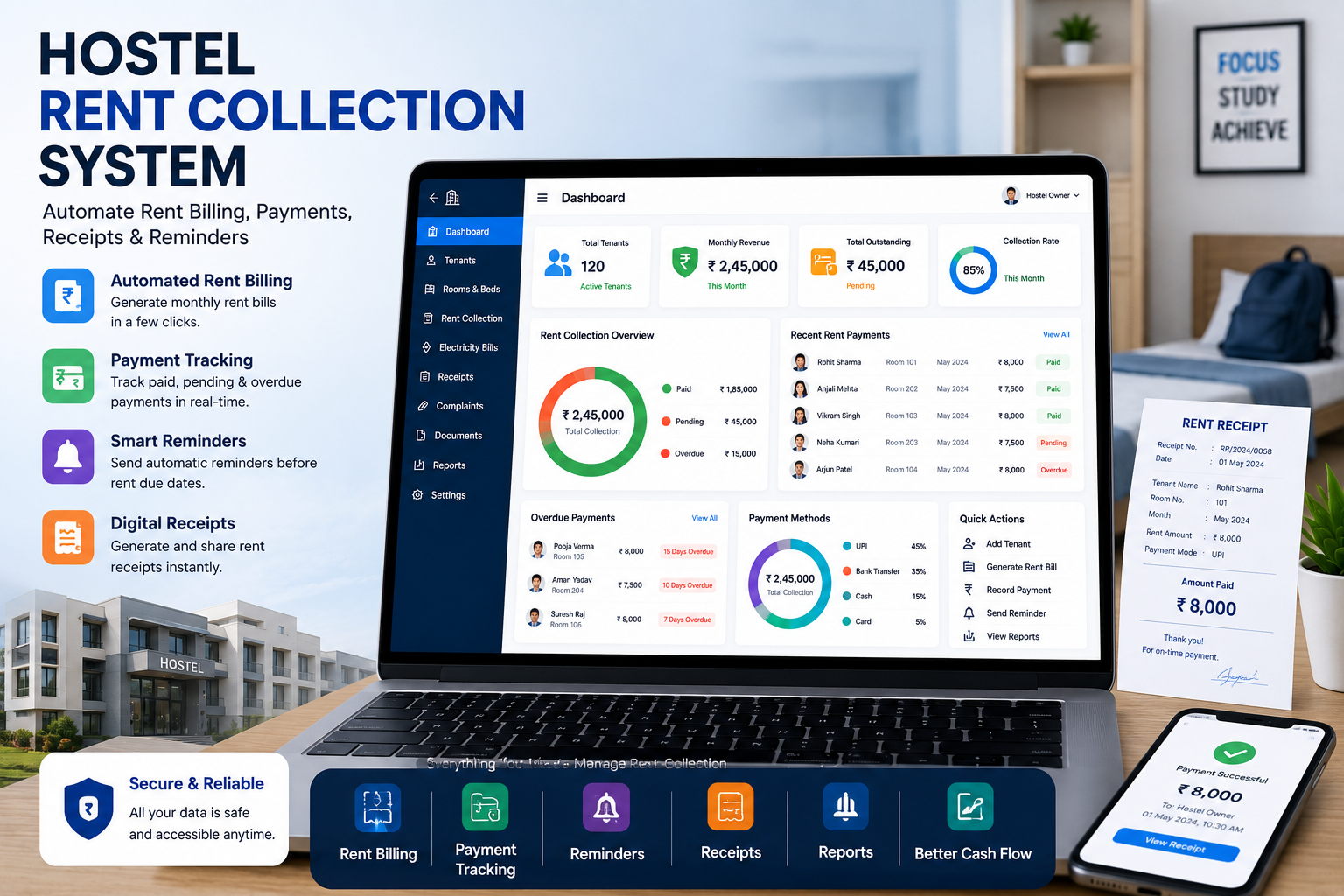
Automate Rental Tax & Rent Collection with RentTenant
Tired of manual rent tracking, tax hassle, and missed receipts? Use RentTenant to generate instant GST & HRA-compliant rent receipts, track income/expenses, and collect rent automatically on WhatsApp.
For Resident Sellers
- Threshold: Applicable only if the transaction value is ₹50,00,000 or more .
- Rate: The buyer must deduct 1% of the higher of the actual sale price or the stamp duty value .
- PAN is Mandatory: The seller must provide their PAN . If not provided, the TDS rate rises sharply to 20% .
- Filing: The buyer deposits the TDS using Form 26QB, which then reflects as tax credit in the seller's Form 26AS/AIS .
For Non-Resident Indian (NRI) Sellers (Section 395)
TDS rules for NRI property sellers are significantly stricter :
- No Minimum Threshold: TDS applies regardless of the transaction value .
- Tax Base: By default, TDS is deducted on the entire sale consideration (gross sale price), rather than just the profit .
- Rate: For long-term capital gains, the TDS rate is 12.5% (plus applicable surcharge and cess) . For short-term capital gains, TDS is deducted at the peak slab rate of 30% (plus surcharge and cess) .
- TAN Required: The buyer must possess a TAN and file Form 27Q .
NRI Solution: Section 197 Lower Deduction Certificate
To avoid massive deductions on the gross sale price, NRI sellers should apply for a Lower or Nil Deduction Certificate under Section 197 from the tax department well before executing the sale . This allows the buyer to deduct TDS only on the actual estimated profit rather than the gross selling price .
Rental Income Tax (Income from House Property)
If you decide not to sell and instead earn rental income, you are taxed annually under the head Income from House Property . The law provides several standard deductions that significantly reduce your annual tax liability :
  Gross Annual Value (GAV)
  Less: Municipal Taxes Paid (Actual basis)
  ==========================================
  = Net Annual Value (NAV)
  Less: 30% Standard Deduction (Section 24(a))
  Less: Home Loan Interest Deduction (Section 24(b))
  ==========================================
  = Taxable Income from House Property
Key Components of the Rental Income Calculation:
1. Gross Annual Value (GAV)
GAV is the higher of the actual rent received or the expected rent based on market/municipal values . If the property remained vacant despite your efforts to rent it out, you can claim a vacancy allowance to deduct the rent of the vacant months from your GAV .
2. Municipal Taxes Paid
You can deduct local municipal and property taxes from your GAV, but only if they were actually paid by you (the owner) during the financial year .
3. Standard Deduction of 30% (Section 24(a))
Once you calculate the Net Annual Value (NAV = GAV − Municipal Taxes), you are entitled to an automatic, flat 30% deduction . No bills, invoices, or receipts for maintenance, repairs, or painting are required to claim this deduction .
4. Home Loan Interest Deduction (Section 24(b))
The interest component of your home loan EMI is highly tax-deductible :
- For Let-Out Properties: Under the Old Tax Regime, there is no upper limit on the interest deduction . You can deduct the entire annual interest paid on your loan against your rental income .
- For Self-Occupied Properties: You can claim interest deductions up to ₹2,00,000 per year under the old tax regime .
- Pre-Construction Interest: Interest paid during the years the property was under construction can be accumulated and claimed in five equal annual instalments starting from the year construction is completed .
5. Joint Home Loan Benefits
If a property is held jointly and both owners are co-borrowers, each co-owner can separately claim the Section 24(b) interest deduction up to ₹2,00,000 for self-occupied properties, proportionate to their ownership share . This effectively doubles the family's tax deductions to ₹4,00,000 per year .
Worked Calculation: Let-Out Property Rental Income
Consider a property that earns ₹25,000 per month in rent, where the landlord paid ₹20,000 in municipal taxes and ₹1,50,000 in annual home loan interest :
- Gross Annual Value (GAV): ₹25,000 × 12 months = ₹3,00,000
- Less: Municipal Taxes Paid: − ₹20,000
- Net Annual Value (NAV): ₹3,00,000 − ₹20,000 = ₹2,80,000
- Less: Standard Deduction @ 30% (Section 24(a)): ₹2,80,000 × 30% = − ₹84,000
- Less: Home Loan Interest (Section 24(b)): − ₹1,50,000
- Taxable Income from House Property: ₹2,80,000 − ₹84,000 − ₹1,50,000 = ₹46,000
Your actual gross earnings were ₹3,00,000, but you only pay income tax on ₹46,000 .
The Old vs. New Tax Regime Dilemma for Landlords
When filing your annual return, you must choose between the Old Tax Regime and the New Tax Regime . This decision is critical because their treatments of house property deductions are fundamentally different :
- Under the Old Tax Regime: You have full access to Section 24(a) standard deductions, unlimited let-out property interest deductions, and the ₹2,00,000 self-occupied interest deduction .
- Under the New Tax Regime: While you still get the 30% standard deduction on let-out properties, you cannot claim home loan interest deductions on self-occupied properties, nor can you set off house property losses against your salary income .
If you have a high-value home loan, the Old Tax Regime will often save you significantly more tax . For debt-free properties, the lower tax slabs of the New Tax Regime are typically more attractive .
Smart Tax-Saving Checklist & Avoidable Pitfalls
To ensure a smooth, audit-free property transaction, keep this checklist and list of common mistakes in mind :
- Crossing the 24-Month Line: Selling a property at 23 months and 28 days forces you into short-term gains, taxed up to 30% . Waiting just a few additional days shifts you into long-term gains at a flat 12.5% . Always verify the exact dates on your registered purchase deed .
- Retain Every Invoice: The Cost of Improvement reduces your taxable capital gains . However, you must possess structural modification invoices, construction material bills, and architect fees . Normal painting or plumbing repair receipts do not qualify as capital improvements .
- The 3-Year Reinvestment Lock-in: If you utilize Section 54 (84) or 54F to save tax by purchasing a new house, you are legally restricted from selling that new house for 3 years . Selling early triggers a withdrawal of your historical tax exemption, retroactively increasing your tax liability .
- File on Time to Carry Forward Losses: If you sell a property at a loss, you can set it off against other capital gains . However, to carry forward unused capital losses for up to 8 subsequent years, you must file your ITR on or before the original due date .
Essential Document Checklist for ITR Filing
To calculate and report property taxes accurately, compile these documents well in advance :
- Purchase Deed & Sale Deed: To prove ownership duration and exact purchase/sale values .
- Brokerage & Stamp Duty Receipts: To deduct transfer-related expenses .
- Renovation/Improvement Bills: To establish the cost of improvement .
- Home Loan Interest Certificates: Issued by your lending bank for Section 24(b) claims .
- Form 26AS & AIS: To verify and claim full credit for the 1% TDS deducted by the buyer .
- Form 16 / ITR Forms: Typically ITR-2 for capital gains on property, or ITR-3 if you carry business income .
Key Takeaways
Navigating property and rental taxation in India does not have to be overwhelming . The fundamental rules are predictable: holding periods dictate tax structures, and reinvestment paths (Sections 54, 54F, and 54EC) offer incredibly robust relief .
The transition to the Income Tax Act, 2025 streamlines the administration of these taxes without altering the core concessions that protect your wealth . The single most effective shield against overpaying is impeccable record-keeping . Maintaining organized deeds, municipal tax receipts, and home improvement bills ensures that your figures are always ready, audit-compliant, and optimized for tax-efficiency .
Disclaimer: This guide is for educational purposes and general information, not personalized tax or financial advice . Capital gains calculations and deductions are subject to individual circumstances and potential changes in direct tax codes . Please consult a qualified Chartered Accountant before finalising any real estate sale or reinvestment strategy .
Source-Backed Owner Checklist
Legal, tax and compliance outcomes are fact-specific. Central statutes, model laws, state enactments, municipal rules, police orders and the signed agreement can produce different answers. Verify the current rule for the property's State/UT and local jurisdiction before acting.
| Check | Practical action |
|---|---|
| Assessment year | Verify the law and return form for that year |
| Property records | Keep deed, rent ledger and municipal-tax receipts |
| Deductions/exemptions | Test every condition and time limit on the official portal |
| Sale/TDS | Confirm resident status, consideration and current form requirements |
Worked example (illustrative, not legal or tax advice)
Illustration only: gross annual rent ₹6,00,000 less eligible municipal taxes paid ₹30,000 gives ₹5,70,000 before any statutory house-property deduction. The final taxable amount depends on ownership, vacancy, interest, chosen regime and the law applicable to that assessment year.
Primary and official sources
- Income-tax Act, 2025 transition guidance — Income Tax Department
- File ITR-2 online — Income Tax Department
- Income tax calculator — Income Tax Department
- Registration Act, 1908 — Section 17 — India Code
- Official GST portal — Goods and Services Tax Network
Important: This article provides general operational information, not legal, tax or investment advice. Rules, notifications and portal processes can change. For a material decision or dispute, consult a qualified professional in the relevant State/UT and verify the current official text.
Related RentTenant Guides
- 11-month rental agreements — Keep agreement structure and transaction records aligned.
- security deposit rules — Separate refundable deposits from rent and documented deductions.
- digital rent collection — Maintain clearer payment records for operational reporting.
Official sources and important disclaimer
- Income-tax Act, 2025: objective, transition and tax-year guidance — Income Tax Department, Government of India.
Tax disclaimer: This article is general educational information, not personalised tax advice. Property classification, acquisition date, residency, deductions, indexation eligibility, TDS and exemption conditions can materially change the result. The 1961 Act continues to govern tax years beginning before 1 April 2026 under transition provisions. Verify the applicable tax year and consult a chartered accountant before filing a return, deducting tax or completing a property transaction.

About the Author
Shilpi Shukla
Shilpi Shukla has 7 years of experience in rental property, hostel, PG, and tenant management. She shares practical insights to help property owners simplify operations, improve tenant experiences, and grow their rental business with RentTenant.