Reduce PG Electricity Bills: Sub-Meters and Energy Controls
Reduce PG electricity costs using transparent sub-metering, efficient equipment and documented resident billing controls.
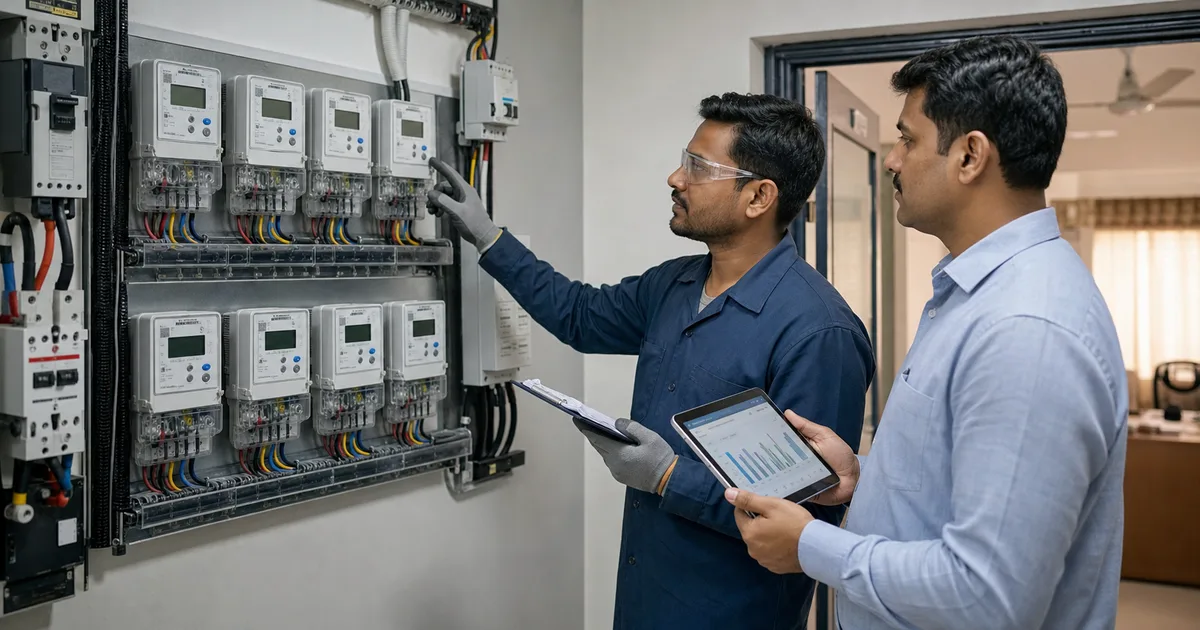
For Paying Guest (PG) owners, hostel operators, and co-living founders across India, electricity expenses represent the single largest variable cost threatening monthly profit margins.
With commercial electricity tariffs ranging from ₹8 to ₹14 per unit across DISCOMs in major metropolitan hubs like Bengaluru, Delhi NCR, Pune, Mumbai, Hyderabad, and Kota, unmanaged power consumption can quickly turn a profitable PG business into a loss-making enterprise.
In traditional PGs where electricity is bundled into flat rent or split equally among occupants, a severe Moral Hazard occurs: residents leave 1.5-ton Air Conditioners running at 18°C while away at work or college, use high-power appliances unrestricted, and ignore energy conservation. Furthermore, equal bill splitting causes intense friction between non-AC occupants and heavy AC users.
The solution? Installing Digital Sub-Meters or Smart Prepaid IoT Sub-Meters.
How do digital sub-meters reduce PG electricity bills by 35% to 50%? Is room sub-metering legal under Indian State Electricity Regulatory Commission (SERC) rules? How do you calculate fair per-unit charges from a commercial master bill?
In this practical 2026 guide, we unpack the legal framework of sub-metering under the Electricity Act 2003, compare Digital vs. Smart Prepaid Sub-Meters, provide a 5-Point Energy Conservation Hardware Checklist, and show how property management platforms like RentTenant automate sub-meter invoicing and WhatsApp utility alerts.
Table of Contents
- The Core Problem: Moral Hazard of Unmetered Electricity
- Legal Standing & DISCOM Tariff Rules in India
- Electricity Act 2003: Check Sub-Metering vs. Reselling Rules
- How to Calculate Effective Per-Unit Rates Legally
- Digital Sub-Meters vs. Smart Prepaid IoT Meters
- Postpaid Digital LCD Meters vs. Prepaid Wi-Fi Smart Relays
- 5-Step Hardware Upgrade Checklist to Slash Power Bills by 40%
- BLDC Fans, 5-Star Inverter ACs, Geyser Timers & Solar Water Heaters
- How to Handle Electricity Billing in PG Rent Agreements
- Automating Sub-Meter Invoicing & Ledgers with RentTenant
- Frequently Asked Questions (FAQs)
The Core Problem: Moral Hazard of Unmetered Electricity
In a PG accommodation without room-level sub-metering, individual residents face zero direct financial consequence for wasting power.
What Happens in Unmetered PGs:
- Continuous AC Running: Air conditioners run 24/7 at minimum temperature settings (18°C) even when rooms are empty.
- High-Wattage Appliances: Heavy use of hair dryers, room heaters, electric kettles, and iron boxes.
- Tenant Friction: Light electricity users (who only use a fan and phone charger) feel cheated when forced to split massive master bills equally with heavy AC users.
The Sub-Metering Shift:
Installing room-wise sub-meters shifts consumption accountability directly to the resident. When occupants know their usage is tracked per unit, overall power consumption drops by 35% to 50% within the first 30 days.
Legal Standing & DISCOM Tariff Rules in India
Property owners frequently ask: Is installing sub-meters legal in India? Can DISCOMs penalize landlords for room sub-metering?
+-------------------------------------------------------------------+
|               SUB-METERING LEGAL & TARIFF MATRIX                  |
+-------------------------------------------------------------------+
|  LEGAL ASPECT                      |  DISCOM & SERC GUIDELINE     |
|  1. Sub-Meter Legality             |  100% LEGAL as internal      |
|                                    |  cost-allocation check meter |
|  2. Profit Reselling Markup        |  STRICTLY PROHIBITED under    |
|                                    |  Electricity Act 2003        |
|                                    |  commercial slab rate        |
|  4. Fixed & Demand Charge Split    |  Prorated transparently      |
|                                    |  across active sub-meters    |
+-------------------------------------------------------------------+
Sub-Metering vs. Reselling Rules (Electricity Act 2003)
- Internal Check Metering is 100% Legal: Installing sub-meters as internal private check devices to distribute actual DISCOM electricity costs among occupants is completely legal across all Indian state electricity boards (DERC, MERC, KERC, UPERC, MSEDCL, Bescom, etc.).
- Prohibition on Commercial Reselling Markup: Landlords cannot act as an unlicensed utility company by adding arbitrary profit markups (e.g., charging ₹20 per unit when the official DISCOM rate is ₹9 per unit) to generate hidden income.
Calculating the Effective Per-Unit Rate Legally
Commercial electricity bills from state DISCOMs include energy charges, fixed demand charges, fuel adjustment surcharges, and electricity duty.
To calculate the fair per-unit rate to charge residents, use this formula:
$$\text{Effective Unit Rate (₹/kWh)} = \frac{\text{Total DISCOM Master Bill Amount (₹)}}{\text{Total Master Units Consumed (kWh)}}$$
Example: If your monthly DISCOM master bill is ₹45,000 for 4,500 total units consumed (including taxes and fixed charges), your effective per-unit rate is $\frac{45,000}{4,500} = \mathbf{\text{₹}10\text{ per unit}}$.
Digital Sub-Meters vs. Smart Prepaid IoT Meters
PG owners can choose between two main sub-metering hardware technologies:
| Parameter | Basic Digital LCD Sub-Meter | Smart Prepaid IoT Sub-Meter |
|---|---|---|
| Average Hardware Cost | ₹600 – ₹1,200 per unit | ₹2,500 – ₹4,500 per unit |
| Reading Mechanism | Physical LCD display check on 1st of month | Remote Wi-Fi/Bluetooth auto-reading via app |
| Payment Model | Postpaid (Billed at end of month with rent) | Prepaid (Tenant recharges wallet before using AC) |
| Disconnection Control | Manual physical MCB tripping | Automatic smart relay cut-off on zero balance |
| Dispute Risk | Low-Medium (Occasional reading mismatch) | Zero (Tenant maintains own usage balance) |
5-Step Hardware Upgrade Checklist to Slash Power Bills by 40%
Sub-metering enforces tenant accountability, but upgrading your building hardware ensures structural energy efficiency:
- Replace Old Fans with BLDC Ceiling Fans: Upgrade traditional 75W fans to 28W BLDC (Brushless Direct Current) motor fans. This cuts ceiling fan electricity consumption by 62%.
- Install 5-Star Dual Inverter ACs with Temperature Locks: Replace old 3-star or non-inverter window ACs with 5-star dual inverter split ACs. Set digital temperature locks at 24°C (saving ~24% power compared to 18°C settings).
- Install Smart Geyser Timer Switches: Install digital timer switches that automatically supply power to bath geysers only during morning hours (6:00 AM – 10:00 AM), eliminating round-the-clock water heating waste.
- Rooftop Solar Water Heating System: Install a rooftop solar water heater for central hot water supply, cutting winter electricity spikes by up to 70%.
- PIR Motion Sensor Corridor Lighting: Install infrared motion sensor LED lights in common hallways, staircases, and dining areas so lights auto-turn off when no one is present.
How to Handle Electricity Billing in PG Rent Agreements
To prevent billing disputes, include explicit electricity clauses in your Leave & License agreement:
Sample Agreement Clause: "Electricity for private rooms shall be measured via individual digital sub-meters installed in each room. The Licensee agrees to pay for actual units consumed at the rate of ₹[X] per unit (derived from DISCOM commercial billing). Electricity charges shall be billed monthly alongside rent and must be cleared by the 5th of every month."
Automate Sub-Meter Invoicing & Utility Billing with RentTenant
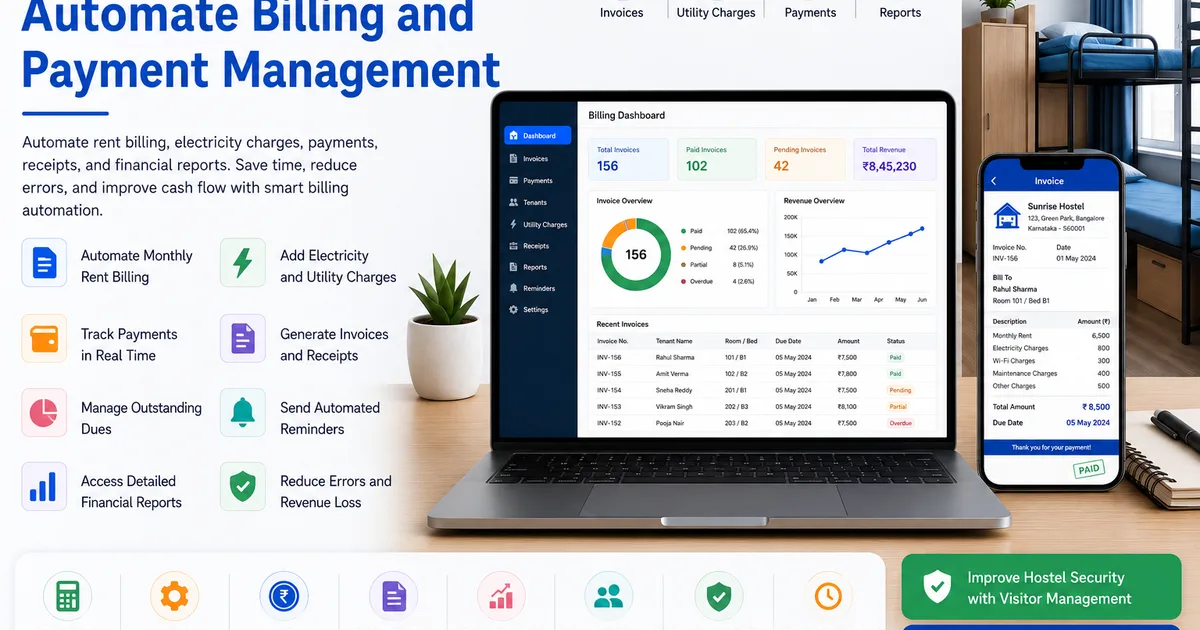
Tired of manual sub-meter math and electricity bill arguments? Use RentTenant to log sub-meter readings, auto-multiply DISCOM unit rates, attach utility invoices to rent, and send WhatsApp receipts.
Automating Sub-Meter Invoicing & Ledgers with RentTenant
Manually recording sub-meter readings for 30 to 100 rooms every month is time-consuming and error-prone. RentTenant provides complete utility billing automation:
Key RentTenant Utility Features:
- Mobile Sub-Meter Reading Entry: Property managers simply enter previous and current sub-meter readings into the RentTenant mobile app.
- Automated Unit Multiplication & Invoicing: The app auto-calculates units consumed, multiplies by the set per-unit rate, and attaches the electricity charge to the tenant's monthly rent invoice.
- Automated WhatsApp PDF Bills: Generates itemized digital invoices with sub-meter reading photos sent directly to residents and parents via WhatsApp.
- Prepaid Smart Meter API Sync: Integrates with smart prepaid IoT meters for automatic balance top-ups and ledger synchronization.
Frequently Asked Questions (FAQs)
Q1. Is sub-metering legal for PG accommodations in India?
Yes. Installing sub-meters as internal private check devices to allocate actual DISCOM electricity costs among residents is 100% legal across all Indian state electricity boards.
Q2. Can a PG owner charge more per unit than the official DISCOM rate?
Electricity recovery must be tested against the state commission's regulations, the DISCOM connection terms and the actual billing model. A transparent sub-meter calculation does not by itself settle whether an activity requires authorisation.
Q3. How much power does a 5-star inverter AC save compared to an old AC?
A 5-Star Dual Inverter AC saves 30% to 40% more electricity compared to an old 3-star or non-inverter AC, especially when operated at a recommended 24°C setting.
Key Takeaways
Reducing PG electricity bills requires a combination of behavioral accountability and energy-efficient hardware. By installing digital or smart prepaid sub-meters, enforcing fair per-unit billing, upgrading to BLDC fans and inverter ACs, and automating utility invoicing with RentTenant, PG owners can slash power costs by up to 50% while maintaining complete billing transparency.
Ready to automate your PG sub-meter billing and rent ledgers? Explore RentTenant Property Management Software Today
Source-Backed Owner Checklist
Legal, tax and compliance outcomes are fact-specific. Central statutes, model laws, state enactments, municipal rules, police orders and the signed agreement can produce different answers. Verify the current rule for the property's State/UT and local jurisdiction before acting.
| Check | Practical action |
|---|---|
| Connection terms | Check sanctioned use, tariff category and DISCOM contract |
| Metering | Use tested meters and preserve readings |
| Allocation | Document common-area and fixed-charge methodology |
| Disputes | Provide the master bill, calculation and correction process |
Worked example (illustrative, not legal or tax advice)
If the master bill is ₹30,000 for 3,000 units, ₹10 is only the simple average. Fixed charges, common-area use, slabs, losses and the DISCOM contract must be allocated transparently; state commission and DISCOM rules govern what may be recovered.
Primary and official sources
- Electricity Act, 2003 — India Code
- Model Acts and tenancy-law resources — Ministry of Housing and Urban Affairs
- Code of Civil Procedure, 1908 — India Code
- Digital Personal Data Protection Act, 2023 — India Code
Important: This article provides general operational information, not legal, tax or investment advice. Rules, notifications and portal processes can change. For a material decision or dispute, consult a qualified professional in the relevant State/UT and verify the current official text.
Related RentTenant Guides
- hostel billing software — Turn meter readings into transparent resident bills.
- PG management workflow — Connect utility controls with occupancy and operations.
- complaint management — Track meter, appliance and billing issues to closure.

About the Author
Shilpi Shukla
Shilpi Shukla has 7 years of experience in rental property, hostel, PG, and tenant management. She shares practical insights to help property owners simplify operations, improve tenant experiences, and grow their rental business with RentTenant.