GST on PG Rent in India: Rates, Exemptions and Compliance
Understand GST exemptions, registration thresholds, bundled services, RCM and invoicing considerations for PG accommodation.

Navigating Goods and Services Tax (GST) compliance is one of the most vital yet misunderstood legal responsibilities for Paying Guest (PG) owners, hostel operators, and co-living founders across India.
With evolving GST Council notifications distinguishing long-term residential stays from short-term commercial hospitality, many PG landlords remain confused: Is GST applicable on PG rent below ₹20,000? What is the 90-day continuous stay rule? Does bundling food and mess services change my tax liability? Do I need GST registration if my annual income exceeds ₹20 Lakhs?
Charging GST incorrectly can alienate student residents and corporate tenants. Conversely, failing to collect GST when legally required can trigger heavy penalties, back-tax interest, and legal notices from the Central Board of Indirect Taxes and Customs (CBIC).
In this practical 2026 guide, we unpack the complete legal framework governing GST on PG Rent in India, the 90-Day & ₹20,000 Exemption Rule, Composite vs. Mixed Supply rules for mess charges, Reverse Charge Mechanism (RCM) on corporate leases, and how property management platforms like RentTenant automate GST-compliant invoicing and tax ledger reporting.
Table of Contents
- The 2026 Core GST Exemption Rule for PG & Hostels
- The "90 Days + ₹20,000/Month" Threshold Rule
- What Happens If Stay Duration or Rent Exceeds Limits?
- GST Registration Thresholds for PG Owners
- Aggregate Turnover Limits (₹20 Lakhs vs. ₹10 Lakhs)
- Do Exclusive Exempt Service Providers Need GSTIN?
- Tax Treatment of Bundled Services (Food, Wi-Fi, Laundry)
- Composite Supply (Single Bundled Monthly Rate)
- Mixed Supply (Itemized Mess & Rent Invoicing)
- Reverse Charge Mechanism (RCM) & Corporate Leases
- Leasing Property to Registered Companies & Corporate Hostels
- Input Tax Credit (ITC) Rules for PG Operators
- Section 17(5) CGST Act Restrictions on Furniture & ACs
- SAC Codes & GST Invoicing Rules for PG Accommodations
- Automating GST Invoicing & Reports with RentTenant
- Frequently Asked Questions (FAQs)
The 2026 Core GST Exemption Rule for PG & Hostels
Under current GST Council notifications, accommodation services provided by PGs, student hostels, and co-living spaces are EXEMPT from GST if and only if BOTH of the following conditions are satisfied:
+-------------------------------------------------------------------+
|             2026 GST EXEMPTION CRITERIA FOR PG STAYS               |
+-------------------------------------------------------------------+
|  CONDITION 1: RENT VALUE CAP          |  CONDITION 2: STAY DURATION|
|  Monthly rent must be <= ₹20,000     |  Continuous stay must be   |
|  per person / resident.               |  >= 90 Days (3 Months).    |
+-------------------------------------------------------------------+
|  RESULT: 100% EXEMPT FROM GST (0% Tax Rate)                       |
+-------------------------------------------------------------------+
The "90 Days + ₹20,000/Month" Rule
- Value Cap: The rental charge charged by the PG operator does not exceed ₹20,000 per person per month.
- Duration Cap: The accommodation is supplied for a continuous stay period of at least 90 days (3 continuous months) to the same individual.
Legal Purpose: This rule protects long-term students and working professionals from tax burdens while preventing hotel operators from disguising commercial tourist lodging as exempt PG accommodation.
What Happens If Conditions Are NOT Satisfied?
- Price or duration condition not met: Re-test classification and rate under the notification in force; do not assume one universal rate without checking the actual supply.
- Transient / Daily Tourist Stays: Short-term stays (e.g., daily lodging or 10-day stays) are treated as commercial hotel lodging and taxed accordingly.
GST Registration Thresholds for PG Owners
Do you need to register for a GSTIN as soon as you open a PG? Not necessarily.
Aggregate Annual Turnover Limits
A PG operator is required to apply for GST registration only if their total aggregate annual turnover across all business activities exceeds:
- ₹20 Lakhs per annum: For general states (Karnataka, Delhi NCR, Maharashtra, Telangana, Gujarat, Uttar Pradesh, Tamil Nadu, West Bengal, etc.).
- ₹10 Lakhs per annum: For Special Category States (Manipur, Mizoram, Nagaland, Tripura, Uttarakhand, etc.).
Do Exclusive Exempt Service Providers Need GSTIN?
Under Section 23(1)(a) of the CGST Act 2017, any person engaged exclusively in the business of supplying goods or services that are wholly exempt from tax is NOT required to register for GST.
Practical example: For a 50-bed PG with ₹35 lakh turnover, do not infer registration exemption solely from resident price and stay duration. Test the operative notification, all supplies and aggregate turnover.
Tax Treatment of Bundled Services (Food, Wi-Fi, Laundry)
Most PGs in India provide bundled packages including room rent, 3 daily meals, Wi-Fi, and housekeeping. How is GST calculated on these bundled packages?
| Supply Type | Billing Structure | Applicable GST Rate |
|---|---|---|
| Composite Supply | Single consolidated bill (e.g., ₹15,000/month rent + food + Wi-Fi). | 0% GST (EXEMPT) if principal stay is <= ₹20k & >= 90 days. |
| Mixed Supply | Itemized invoice (e.g., ₹14,000 Rent + ₹4,000 Mess Fee billed separately). | Rent is 0% Exempt; Food Mess is taxed at 5% GST (No ITC). |
Composite Supply (Recommended Best Practice)
Bundled PG supplies require classification under the operative GST notification and supply rules. Price and duration alone do not establish exemption; obtain transaction-specific advice where material.
Mixed Supply (Itemized Separate Bills)
If rent and food charges are billed separately under distinct line items or handled by an independent third-party mess vendor:
- The accommodation portion remains exempt (if ≤ ₹20,000 & 90+ days).
- The food/mess charges are classified under outdoor catering/restaurant services, attracting 5% GST without Input Tax Credit.
Reverse Charge Mechanism (RCM) & Corporate Leases
A critical tax area arises when a property owner leases a commercial PG building to a Registered Corporate Body / Company (which uses it to house its employees):
- Reverse charge: RCM depends on the property, supplier/recipient status, use and notification in force. Confirm the facts before invoicing or paying tax.
- The property owner does not collect GST on the invoice; the corporate tenant pays 18% GST directly to the government ledger.
Automate GST Invoicing & Tax Ledgers with RentTenant
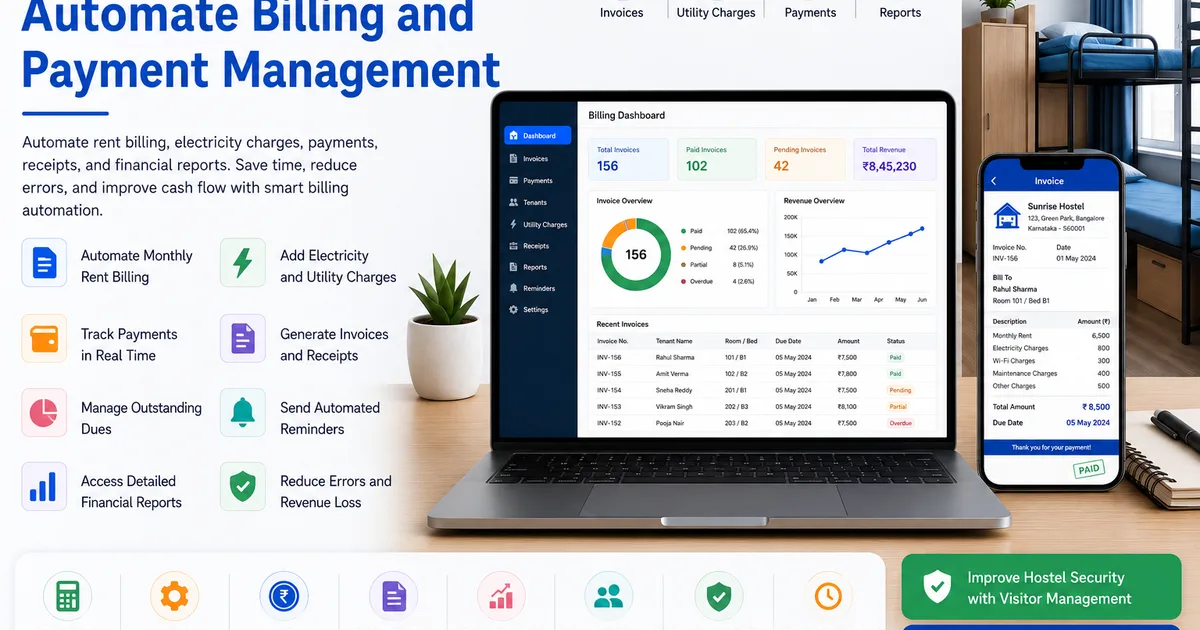
Tired of manual GST calculations and SAC code confusion? Use RentTenant to automate GST exemption checks, digital tax invoices, SAC 9963 tagging, and GSTR report exports.
Input Tax Credit (ITC) Rules for PG Operators
Can PG owners claim Input Tax Credit (ITC) on air conditioners, beds, furniture, CCTV cameras, and renovation expenses?
- Exempt PG Operators (0% GST): Under Section 17(2) of CGST Act, operators supplying exempt services cannot claim Input Tax Credit on capital goods, maintenance, or utility expenses.
- Taxable Commercial PG Operators (12% GST): Operators charging 12% GST on stays exceeding ₹20,000/month can claim ITC on commercial purchases (excluding immovable building construction under Section 17(5)(c)).
SAC Codes & GST Invoicing Rules
When issuing tax invoices for taxable PG stays, use the correct Services Accounting Code (SAC):
- SAC 996311: Room or unit accommodation services provided by PGs, hostels, and guest houses.
- SAC 996331: Services provided by cafeterias, mess halls, and food pantries.
Automating GST Invoicing & Reports with RentTenant
Manually checking 90-day stay conditions, tracking ₹20,000 rent thresholds, and calculating GST ledgers creates massive accounting errors. RentTenant automates complete GST compliance for PG operators:
Key RentTenant GST Features:
- Automated Exemption Rule Checker: Evaluates each resident’s stay duration and monthly rent to automatically determine 0% Exempt status or apply 12% GST.
- GST-Compliant Digital Receipts: Generates WhatsApp & PDF invoices with auto-tagged SAC codes (9963), GSTIN numbers, and itemized tax breakdowns.
- Corporate RCM Ledger Management: Supports corporate B2B leases with Reverse Charge Mechanism tagging.
- 1-Click CA Audit Export: Exports ready-to-file GSTR-1 and GSTR-3B tax reports in Excel format for your chartered accountant.
Frequently Asked Questions (FAQs)
Q1. Is GST applicable on PG rent below ₹20,000 per month?
Not automatically. Those facts may be relevant under an operative notification, but recipient, continuity, bundled services and other conditions must also be verified.
Q2. What is the GST rate if a resident stays for only 30 days?
If a resident stays for less than 90 days, the stay loses long-term residential exemption and is taxed at 12% GST (if the owner's turnover exceeds ₹20 Lakhs).
Q3. Is GST registration mandatory if my PG income crosses ₹20 Lakhs?
If your entire PG income comes from wholly exempt stays (rent ≤ ₹20,000 & stay ≥ 90 days), you are exempt from GST registration under Section 23 of the CGST Act.
Key Takeaways
Understanding GST on PG Rent in 2026 is essential for maintaining tax compliance while keeping pricing competitive. By applying the "90 Days + ₹20,000" exemption rule, structuring food packages as composite supplies, and using RentTenant for automated GST invoicing and reporting, PG operators can run a transparent, audit-proof, and hassle-free business.
Ready to automate your PG GST invoicing and rent ledgers? Explore RentTenant Property Management Software Today
Source-Backed Owner Checklist
Legal, tax and compliance outcomes are fact-specific. Central statutes, model laws, state enactments, municipal rules, police orders and the signed agreement can produce different answers. Verify the current rule for the property's State/UT and local jurisdiction before acting.
| Check | Practical action |
|---|---|
| Supply date | Use the notification in force on that date |
| Recipient and use | Record who receives the service and its actual use |
| Package components | Test accommodation, food and amenities under supply rules |
| Registration/RCM | Confirm aggregate turnover and notification-specific conditions |
Worked example (illustrative, not legal or tax advice)
A ₹18,000 monthly package for 100 days should not be labelled exempt from two numbers alone. Verify the operative notification, recipient, continuity, bundled services and registration position for the supply date.
Primary and official sources
- Recommendations of the 54th GST Council meeting — GST Council
- Central Tax (Rate) notifications — CBIC
- GST goods and services rates — CBIC
- Official GST portal — Goods and Services Tax Network
Important: This article provides general operational information, not legal, tax or investment advice. Rules, notifications and portal processes can change. For a material decision or dispute, consult a qualified professional in the relevant State/UT and verify the current official text.
Related RentTenant Guides
- property and rental tax guide — Separate income-tax treatment from GST questions.
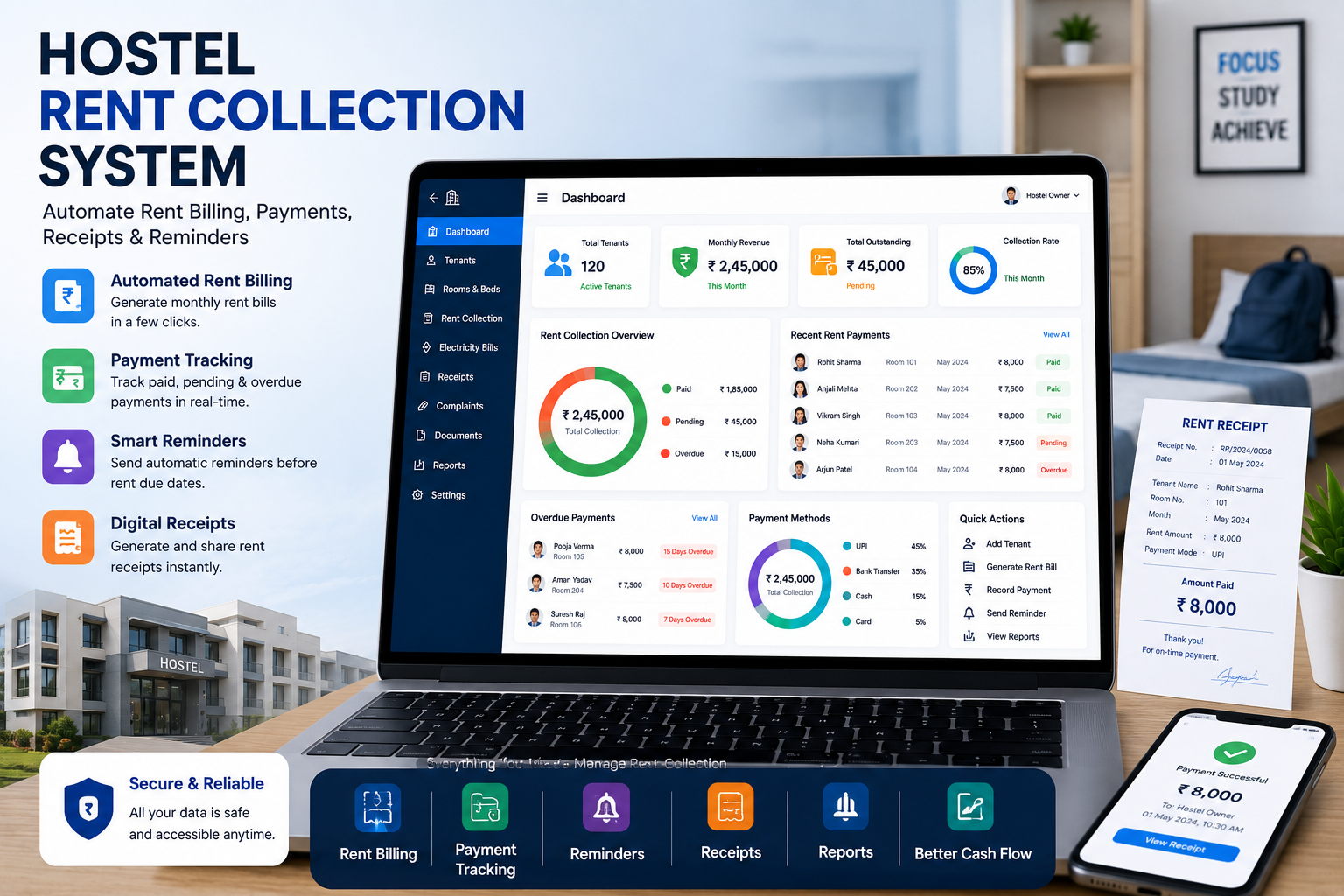
- hostel rent collection system — Keep rent and service payment records organized.
- hostel billing software — Create consistent bills, receipts and payment histories.

About the Author
Shilpi Shukla
Shilpi Shukla has 7 years of experience in rental property, hostel, PG, and tenant management. She shares practical insights to help property owners simplify operations, improve tenant experiences, and grow their rental business with RentTenant.