The Satya Niketan PG Collapse (2026): Structural Safety Laws, Landlord Liability & MCD Compliance for Delhi PGs
A comprehensive 2026 legal and safety analysis of the Satya Niketan PG building collapse in Delhi. Learn about root causes of structural failure, mandatory MCD Form-4 structural stability audits, invalidity of landlord liability waiver clauses under Contract Act Sec 23, Culpable Homicide charges (IPC 304 / BNS 105), and RentTenant digital safety vaults.
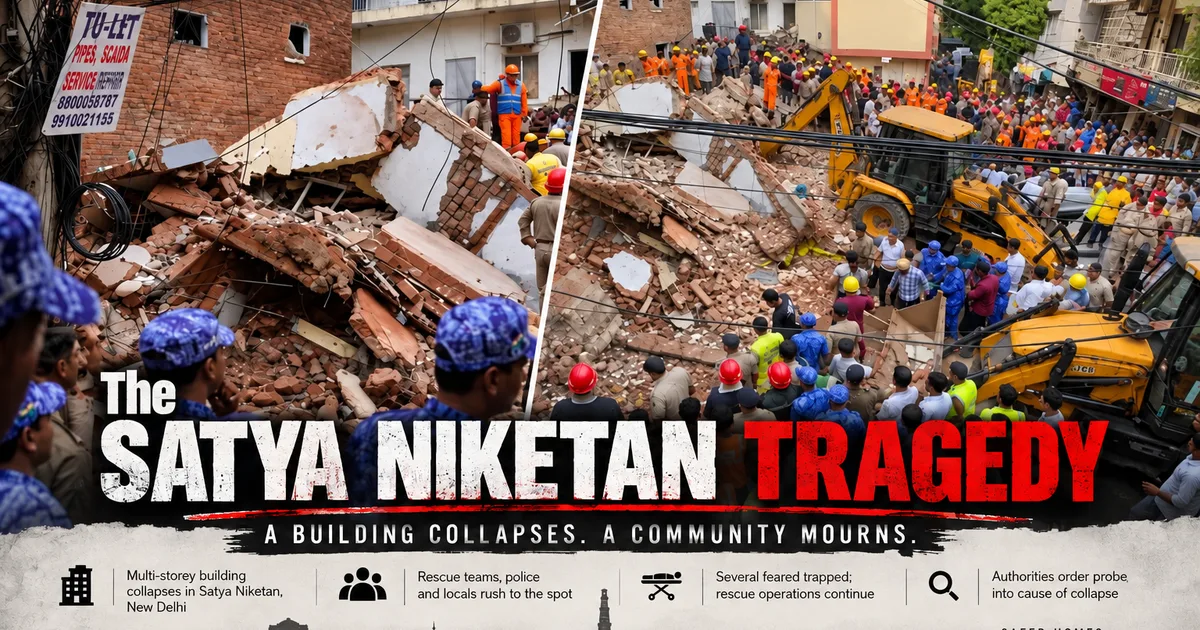
On September 6, 2026, a tragic incident shook the student community in Delhi: a multi-story residential building operating as a Paying Guest (PG) accommodation in Satya Niketan (DU South Campus) collapsed, taking seven lives and injuring multiple residents.
The Satya Niketan tragedy has sent shockwaves across Delhi NCR's rental real estate landscape, triggering immediate city-wide inspection drives by the Municipal Corporation of Delhi (MCD), mandatory structural audit orders by the Delhi Government, and strict criminal prosecution of negligent property owners.
For years, many informal PG operators across Delhi student hubs—including Satya Niketan, Vijay Nagar, Hudson Lane, Mukherjee Nagar, Laxmi Nagar, and Kalu Sarai—relied on unsanctioned vertical expansion, adding 5th and 6th floors onto old foundations without structural engineering approval.
What caused the Satya Niketan building collapse? Are "liability waiver clauses" in PG rent agreements legally valid? What are the new mandatory MCD Structural Stability Audit rules? What criminal liabilities do landlords face under Indian law?
In this comprehensive 2026 analysis, we break down the Anatomy of the Satya Niketan Collapse, legal landlord liabilities under Section 304 IPC / Section 105 BNS, the invalidity of contract waiver clauses, step-by-step MCD Structural Audit Protocols, and how modern property management platforms like RentTenant help PG owners digitize safety compliance and provide 1-click Emergency SOS Alerts for residents.
Table of Contents
- The Satya Niketan Tragedy: Anatomy of a Structural Failure
- Root Causes: Unsanctioned Vertical Expansion & Basement Excavation
- The Myth of "Liability Exclusion Clauses" in Rent Agreements
- Why Contractual Waivers Cannot Absolve Landlord Negligence
- Landlord Criminal & Civil Liabilities Under Indian Law
- Culpable Homicide (IPC 304 / BNS 105) & Property Sealing Rules
- Post-Collapse Delhi Regulatory Framework
- Mandatory MCD Structural Audits & Centralized PG Licensing Portal
- Step-by-Step Guide: How to Conduct an MCD Structural Audit
- Hiring Empanelled Engineers & Form-4 Stability Certification
- Automating Structural & Fire Safety Compliance with RentTenant
- Frequently Asked Questions (FAQs)
1. The Satya Niketan Tragedy: Anatomy of a Structural Failure
The collapse of the Satya Niketan PG building was not an unpredictable "act of God"; it was the cumulative result of systematic structural overload and regulatory non-compliance.
|               SATYA NIKETAN PG COLLAPSE: ANATOMY OF FAILURE       |
|  PRIMARY CAUSE 1: UNSANCTIONED VERTICAL EXPANSION                 |
|  - Building 5-6 floors on old 2-story low-density foundation.     |
|                                                                   |
|  PRIMARY CAUSE 2: UNAPPROVED BASEMENT EXCAVATION                  |
|  - Digging basement pillars without structural bracing support.   |
|                                                                   |
|  PRIMARY CAUSE 3: SEVERE WATERLOGGING & CONCRETE EROSION          |
|  - Water seepage weakening load-bearing masonry pillars.         |
|                                                                   |
|  PRIMARY CAUSE 4: ABSENCE OF STRUCTURAL STABILITY AUDIT           |
|  - Operating commercial student housing with 0% structural checks.|
Key Contributing Factors Identified by Investigators:
- Unsanctioned Vertical Load: The building was originally sanctioned for a low-density 2-story residential structure. Over the years, the owner added 4 additional floors, putting immense compressive stress on unreinforced load-bearing walls.
- Unapproved Basement Modifications: Unsanctioned excavation work conducted in the basement without lateral soil retention walls compromised the building's main foundation pillars.
- Monsoon Waterlogging & Seepage: Prolonged water seepage eroded masonry strength, triggering sudden structural shear failure.
2. The Myth of "Liability Exclusion Clauses" in Rent Agreements
Following the collapse, investigations revealed that the property's onboarding rent agreement contained an aggressive Liability Waiver Clause:
"The Tenant agrees that the Management shall not be held responsible or legally liable for any injury, loss of life, or property damage resulting from structural collapse, fire, natural disaster, or building failure."
The Legal Truth: Liability Waivers are better documented ILLEGAL
Legal experts, the Delhi High Court, and Consumer Courts have repeatedly affirmed that contractual waiver clauses attempting to excuse structural negligence are illegal and unenforceable under Indian law.
- Section 23 of the Indian Contract Act, 1872: Any contract clause opposed to public policy or seeking to exempt a party from criminal negligence is unlawful and void ab initio (invalid from the start).
- Statutory Duty of Care: Property owners have an unalienable statutory duty under municipal laws to ensure building safety. A private contract cannot override public safety statutes.
3. Landlord Criminal & Civil Liabilities Under Indian Law
When a building collapse or fire safety breach results in loss of life, the property owner faces severe criminal prosecution:
|               LANDLORD CRIMINAL & CIVIL LIABILITY MATRIX           |
|  OFFENSE / CHARGE         |  LEGAL CONSEQUENCE & STATUTE          |
|  - Culpable Homicide      |  IPC Section 304 / BNS Section 105    |
|                            |  (Up to 10 Years Imprisonment)        |
|  - Negligent Conduct      |  IPC Section 304A / BNS Section 106   |
|  - MCD Property Sealing   |  Immediate Sealing & Demolition Order |
|  - Financial Compensation |  Heavy court-mandated restitution to  |
|                            |  victim families                     |
- IPC Section 304 / BNS Section 105: Culpable Homicide Not Amounting to Murder — Applied when an owner knowingly constructs illegal floors or ignores structural warnings. Carries up to 10 years imprisonment.
- IPC Section 304A / BNS Section 106: Causing Death by Negligence.
4. Post-Collapse Delhi Regulatory Framework
In the aftermath of the Satya Niketan tragedy, the Delhi Government and the Lieutenant Governor enacted sweeping regulatory reforms:
|            POST-COLLAPSE DELHI PG REGULATORY FRAMEWORK            |
|  1. MANDATORY STRUCTURAL AUDITS  ->  All PGs >15 yrs must produce |
|                                      Form-4 Stability Certificate.|
|  2. CENTRALIZED PG PORTAL        ->  Delhi Govt web portal for    |
|                                      mandatory PG licensing.      |
|  3. DEMOLITION & SEALING DRIVES ->  MCD sealing unauthorized 5th  |
|                                      and 6th floors >15 meters.   |
|  4. MANDATORY FIRE NOC           ->  Enforcement of DFS fire NOCs |
|                                      for high-density PGs.        |
5. Step-by-Step Guide: How to Conduct an MCD Structural Audit
To protect your building from sealing orders and ensure tenant safety, follow this 4-step structural audit process:
Step 1: Hire an MCD-Empanelled Structural Engineer
Engage a certified structural engineer registered with the Municipal Corporation of Delhi (MCD).
Step 2: Perform Non-Destructive Testing (NDT)
The structural consultant conducts advanced non-destructive field tests:
- Rebound Hammer Test: Measures surface hardness and concrete compressive strength.
- Ultrasonic Pulse Velocity (UPV) Test: Detects internal cracks, voids, and honeycomb structures inside concrete pillars.
- Core Cutter Test: Extracts concrete core samples for lab compression testing.
Step 3: Obtain Form-4 Structural Stability Certificate
Upon passing inspection, the engineer issues an official Form-4 Structural Stability Certificate certifying the building's load-bearing capacity for residential occupancy.
Step 4: Submit Certificate to MCD Zonal Office
File the certificate with your local MCD Zonal Office and upload a digital copy to your property management dashboard.
Digitize Structural Audits & Safety Compliance with RentTenant
Build 100% tenant and parent trust post-Satya Niketan. Use RentTenant to store certified Form-4 Structural Stability Certificates, Fire NOCs, and MCD permits, and equip residents with 1-click Emergency SOS alerts.
6. Automating Structural & Fire Safety Compliance with RentTenant
Building resident trust post-Satya Niketan requires complete safety transparency. RentTenant empowers PG operators to digitize safety management:
Key RentTenant Safety Features:
- Digital Safety & Structural Vault: Store Form-4 Structural Stability Certificates, MCD Building Plans, Fire NOCs, and Electrical Audit logs in your property's public transparency portal.
- Resident Safety Verification Link: Share verified safety credentials with prospective tenants and parents on WhatsApp to build better documented booking trust.
- 1-Click Emergency SOS Alert System: Equips residents with an instant in-app emergency alert button connecting directly to property wardens, security, and emergency contacts.
- Digital Maintenance Ticketing: Residents log structural dampness, wall cracks, or electrical issues with photo evidence for immediate engineering repair.
7. Frequently Asked Questions (FAQs)
Q1. What caused the Satya Niketan PG building collapse in Delhi?
The collapse was caused by unsanctioned vertical expansion (building 5-6 floors on old 2-story foundations), unapproved basement excavation work, and severe waterlogging that compromised foundation integrity.
Q2. Is a liability waiver clause in a PG rent agreement legally valid?
No. Under Section 23 of the Indian Contract Act 1872, liability waiver clauses attempting to excuse a landlord from structural safety or criminal negligence are better documented illegal and void.
Q3. How can a PG owner get an MCD Structural Stability Certificate in Delhi?
Hire an MCD-empanelled structural engineer to conduct Non-Destructive Testing (NDT) on building pillars and issue a Form-4 Structural Stability Certificate.
Conclusion
The Satya Niketan collapse serves as a stark reminder that structural safety is an uncompromisable duty for every PG owner and hostel operator in Delhi. By conducting mandatory MCD structural audits, obtaining Fire NOCs, discarding invalid contract waiver clauses, and digitizing safety compliance with RentTenant, property owners can protect human lives, avoid criminal liabilities, and operate a secure, trusted student housing business.
Ready to manage a safe, compliant, and tech-enabled PG property? Explore RentTenant Property Management Software Today
Review note: General information only. Legal, safety and regulatory requirements vary by state and local authority; verify the current official source and obtain professional advice before relying on a material decision.
Verify current official notices
This is a current-event topic. Confirm every incident, date, casualty, notice and liability statement against the latest Delhi Government, MCD, police, fire or court record. If an official record is unavailable, describe the point as unverified rather than factual.
Official source authority
Use the linked primary portals above as the current reference. State portals and notifications control where they differ from general guidance.
Practical checklist
| Step | Owner/tenant action | Evidence to keep |
|---|---|---|
| 1 | Confirm the applicable state, city and agreement terms | Current official URL and signed agreement |
| 2 | Record the issue with date, people and exact amount | Photos, invoices, messages and dated log |
| 3 | Send a clear written request or notice | Email/WhatsApp export and delivery proof |
| 4 | Escalate only through the relevant authority or forum | Complaint number and acknowledgement |
What to do next
- Save the agreement, identity/occupancy records and all dated evidence.
- Verify the latest state or municipal rule before taking action.
- Ask the counterparty for an itemised response and a reasonable timeline.
- Obtain advocate, CA, fire-safety or food-safety advice where the decision is material.
Evidence table for a current incident
| Claim | Acceptable primary evidence | If unavailable |
|---|---|---|
| Date/location | Official notice or authority record | Label as unverified |
| Casualty/damage | Police, fire, hospital or court record | Do not state as fact |
| Liability | FIR, order or court finding | Use “alleged” and cite source |

About the Author
Jyostna Deshmukh
Jyostna Deshmukh is a real estate and rental property professional from Maharashtra with over six years of hands-on experience in rental operations and technology-enabled tenant management. Her expertise spans rental properties, hostels, PG accommodation, tenant relations and day-to-day property operations. Through her writing, she shares practical insights into rental challenges, real estate practices and technology-driven property management. She explores how automation can help property owners simplify operations, improve tenant experiences and build more transparent, efficient and scalable rental businesses.