ROR Gujarat Land Records Online (2026): Step-by-Step 7/12, 8A AnyROR Check Guide, Purpose & FAQs
A comprehensive 2026 revenue land records guide for Gujarat landowners, property buyers, and tenants. Learn how to check and download 7/12 Satbara (VF 7), VF 8A Khata extracts, VF 6 mutation entries, and Urban Property Cards online via AnyROR (anyror.gujarat.gov.in) and MyPatta. Includes statutory analysis under Gujarat Land Revenue Code 1879, Old vs New Tenure rules, Certified Copy vs ROR comparison, and FAQs.
Author: Shilpi Shukla Published Date: September 2026 Category: Property Tax & Legal Compliance Read Time: 12 min read
Whether you are an agricultural landowner in Gujarat, a urban real estate investor in Ahmedabad or Surat, a tenant, or a financial institution verifying property collateral for a home loan, accessing accurate Record of Rights (ROR) is the single most critical step in property due diligence.
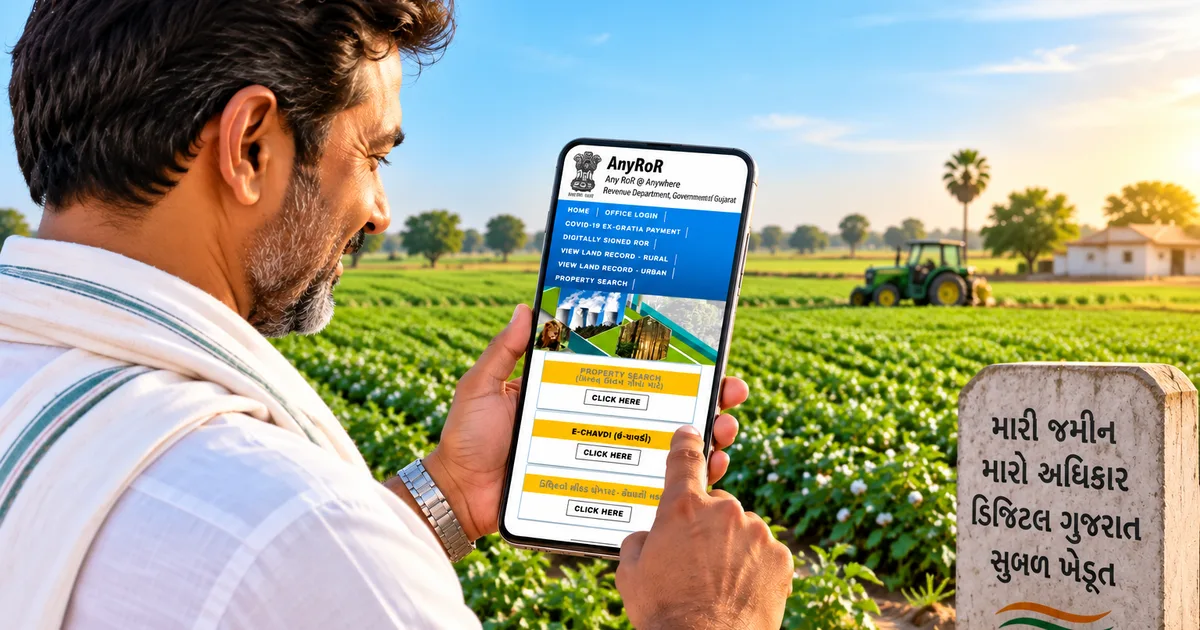
In Gujarat, digitized land administration powered by the E-Dhara system and the official AnyROR portal (anyror.gujarat.gov.in) allows citizens to view, verify, and download crucial revenue land records—including Village Form 7 (7/12 Satbara), Village Form 8A (Khata extract), Village Form 6 (Mutation entries), and Urban Property Cards—from anywhere in the world.
This comprehensive guide provides an exhaustive walkthrough of ROR Gujarat: what it is, its legal foundation under the Gujarat Land Revenue Code 1879, the detailed anatomy of each land form, step-by-step instructions for online checking via AnyROR and MyPatta, key differences between a Certified Copy and an ROR extract, practical purposes, and answers to frequently asked questions.
Key Takeaways
- Master Legal Record: ROR (Record of Rights) is the official revenue document certifying land ownership, survey numbers, total area, land classification, and encumbrances in Gujarat.
- Core Village Forms: A complete ROR comprises VF 7 (7/12 Satbara) for survey details, VF 12 for crop patterns, VF 8A for owner khata ledgers, and VF 6 (Hakku Patrak) for mutation logs.
- AnyROR Portal: The Gujarat Government’s
anyror.gujarat.gov.inportal offers 24/7 digital access to Rural and Urban land records derived from the E-Dhara database. - Instant Mobile Access: Platforms like MyPatta (
mypatta.in) allow instant retrieval and cloud archival of ROR 7/12 documents, pairing them seamlessly with Property Tax Receipts and Encumbrance Certificates. - Certified Copy vs ROR: A Certified Copy is an officially attested registered title deed from the Sub-Registrar Office (SRO), whereas an ROR is a revenue record showing current occupancy, land tenure, and mutation history.
Table of Contents
- What is ROR (Record of Rights) in Gujarat?
- Legal Foundation: Gujarat Land Revenue Code & E-Dhara
- Anatomy of ROR Land Records: Understanding Village Forms
- Step-by-Step: How to Check ROR Online on AnyROR Gujarat
- How to Download ROR Instantly via MyPatta App & Web
- Difference Between Certified Copy & ROR Extract
- Primary Purpose & Real-World Uses of ROR Gujarat
- Frequently Asked Questions (FAQs)
- Conclusion & Final Legal Tips
1. What is ROR (Record of Rights) in Gujarat?
The Record of Rights (ROR) in Gujarat is an official register maintained by the State Revenue Department that records the legal rights, liabilities, and title status of landholders across all rural villages and urban city survey wards.
It serves as the definitive reference document for determining who holds occupancy rights over a piece of land, whether the land is classified as Old Tenure (Juni Shart) or New Tenure (Navi Shart), whether any financial liens or bank mortgages exist, and how the ownership has transferred over time through sales, gifts, partitions, or inheritance.
In daily real estate terminology, when people in Gujarat refer to obtaining their "7/12", "Satbara", "Khata 8A", or "Nakal", they are requesting components of the state's official ROR database.
2. Legal Foundation: Gujarat Land Revenue Code & E-Dhara
The Legislative Basis
The legal framework governing ROR in Gujarat is established under Sections 135A to 135L of the Gujarat Land Revenue Code (GLRC), 1879. Under Section 135J of the Code, entries recorded in the Record of Rights carry a rebuttable presumption of truth in courts of law under Section 35 of the Indian Evidence Act, 1872.
While revenue records do not create absolute underlying title by themselves (which requires a registered sale deed), they serve as paramount evidence of physical possession, revenue liability, and administrative ownership recognized by the State Government.
The E-Dhara Digitization Revolution
Prior to the early 2000s, land records were manually written by village officers (Talatis) in physical books. This system was prone to delayed entries, unauthorized overwriting, and loss during natural disasters.
To eliminate middleman exploitation and guarantee transparency, the Gujarat Government launched the E-Dhara Project. E-Dhara digitized over 1.5 crore land records across all 33 districts and 250+ talukas. Today, E-Dhara centers operating at Taluka Mamlatdar offices process all property mutations electronically, directly feeding real-time updates into the AnyROR public portal.
3. Anatomy of ROR Land Records: Understanding Village Forms
An agricultural Record of Rights (ROR) extract in Gujarat consists of four primary Village Forms (VF). Understanding what each form contains is vital for property buyers and title verification experts:
| Village Form | Form Name | Primary Information Recorded | Key Usage |
|---|---|---|---|
| VF 7 | Satbara / 7/12 Extract | Survey/Block No., Landowner Name(s), Total Area, Tenure Type, Encumbrances & Bank Mortgages | Verifying land ownership, plot dimensions, and tenure restrictions |
| VF 12 | Hak-Prakar / Crop Record | Seasonal crops grown (Kharif/Rabi), irrigation source, cultivated vs uncultivated land | Agricultural loan sanction, crop insurance, PM-KISAN subsidy |
| VF 8A | Khata Extract | Consolidated list of ALL survey numbers owned by a landholder in that village | Verifying total land ceiling limit and revenue tax assessment |
| VF 6 | Hakku Patrak / Mutation Register | Chronological history of ownership changes (Sale, Inheritance, Gift, Mortgage, NA approval) | Tracing title lineage and verifying legality of past property transactions |
Village Form 7 (VF 7 - Satbara / 7/12)
VF 7 is the core extract of the ROR. Key sections include:
- Header Details: District, Taluka, Village, and Survey/Block Number.
- Total Area: Measured in Hectares-Are-Square Meters (Ha.Are.Sq.M).
- Occupant Details (Kabjedar): Full names of all legal co-owners and their respective fractional shares.
- Tenure Classification (Satta-Prakar):
- Juni Shart (Old Tenure): Freehold land. The owner has unrestricted rights to sell, transfer, mortgage, or convert the land for non-agricultural use.
- Navi Shart (New Tenure): Restricted land allotted by government under specific schemes or land ceiling laws. It cannot be sold, leased, or converted without prior written approval from the District Collector and payment of a state premium (Nazarana).
- Other Rights & Encumbrances (Bja Hakku): Records active bank hypothecations, agricultural credit liens, court injunction orders, or tenancy rights under the Gujarat Tenancy and Agricultural Lands Act, 1948.
Village Form 12 (VF 12 - Crop Record)
Printed alongside VF 7 (forming the famous 7/12 combination), VF 12 details:
- Name of crops cultivated (e.g., Cotton, Groundnut, Wheat, Paddy, Castor).
- Area under cultivation versus uncultivated wasteland (Kharaba).
- Mode of irrigation (Well, Borewell, Canal, Rainfed).
- Name of actual cultivator (whether self-cultivated by Kabjedar or tenant farmer).
Village Form 8A (VF 8A - Khata Extract)
VF 8A acts as a master ledger card for an individual landowner (Khatedar) within a specific village. If a farmer owns 5 different survey plots across the village, VF 8A lists all 5 survey numbers, their respective areas, and the consolidated land revenue tax (Aakar) payable to the government.
Village Form 6 (VF 6 - Mutation Register)
Also known as Hakku Patrak, VF 6 records every change of land ownership or right:
- Entry Number (Nondh Number): A sequential tracking number assigned to every mutation application.
- Transaction Type: Sale Deed (Vechan), Inheritance (Varsai), Gift Deed (Bakhshis), Partition (Vechani), Mortgage (Bojo), or Non-Agricultural permission (NA Hukham).
- Section 135D Notice Status: Public notice issued to interested parties allowing 30 days for objections before entry certification by the Circle Officer.
4. Step-by-Step: How to Check ROR Online on AnyROR Gujarat
The official portal for accessing land records online is https://anyror.gujarat.gov.in/. Follow these simple steps:
[ Visit anyror.gujarat.gov.in ]
             |
             +---> Select "View Land Record - Rural" OR "View Land Record - Urban"
             |
             +---> Choose Document Type (VF 7, VF 8A, VF 6, Property Card)
             |
             +---> Select District -> Taluka -> Village
             |
             +---> Enter Survey / Block / Khata Number
             |
             +---> Enter Captcha & Click "Get Record Detail"
             |
             v
 [ View / Download Land Record Extract ]
Automate Property Records & Legal Compliance with RentTenant
Manage your property documents, rent agreements, tenant verification, and revenue compliance across Gujarat seamlessly with RentTenant software.
Rural Land Records Search (VF 7, 8A, 6)
- Open your browser and go to
https://anyror.gujarat.gov.in/. - On the main homepage, click on "View Land Record - Rural".
- Select the desired search option from the dropdown menu:
- VF-7 Survey No. Details (for 7/12 extract)
- VF-8A Khata Details (for owner khata ledger)
- VF-6 Entry Details (for mutation register)
- 135-D Notice for Mutation (for pending public notices)
- Old Scanned VF-7/12 Details (for historical searches prior to 2004)
- Select your District, Taluka, and Village from the respective dropdown lists.
- Enter your Survey Number / Block Number or Khata Number.
- Type the exact numerical Security Captcha code shown on the screen.
- Click "Get Record Detail". Your 7/12 or 8A extract will be displayed instantly on the screen for viewing and printing.
Urban Land Records Search (Property Card)
For land situated within urban municipal city survey limits (such as Ahmedabad, Vadodara, Surat, Rajkot, Bhavnagar):
- On
anyror.gujarat.gov.in, click on "View Land Record - Urban". - Select "Property Card Details" or "Know Survey No. by UPIN".
- Choose the relevant City Survey Office (CSO), Ward Name, and City Survey / Sheet Number.
- Enter the Captcha code and click "Get Record Detail".
- The Property Card showing property owner name, dimensions in square meters, and tax assessment will appear.
Downloading Digitally Signed Certified Copies
While viewing records on AnyROR is free for informational purposes, official transactions (such as bank loan applications, court submissions, or land registry) require a Digitally Signed Certified Copy:
- On the AnyROR homepage, select "AnyROR @ Anywhere" or visit the state digital portal.
- Sign in using your registered mobile number and OTP.
- Select "Digitally Signed ROR (7/12 & 8A)".
- Pay the government prescribed nominal fee (approx ₹15 per document page) via digital payment gateways.
- Download the PDF containing an official electronic signature and QR code verified under Section 65B of the Information Technology Act, 2000.
5. How to Download ROR Instantly via MyPatta App & Web
For property owners, NRI buyers, real estate consultants, and tenants who want a seamless, fast experience without navigating complex government dropdown menus or encountering peak-hour portal slowdowns, MyPatta (mypatta.in) offers an intuitive solution:
- Access MyPatta: Visit mypatta.in or download the mypatta App on Android or iOS.
- Select Document: Select Gujarat -> ROR (Record of Rights).
- Enter Location Details: Select your District, Taluka, Village, and Survey/Block Number.
- Search & Retrieve: Click Search to fetch your official ROR document.
- View & Download PDF: View your document on screen and download/share the crisp PDF directly to your device.
- Unified Property Management: MyPatta allows you to archive ROR extracts alongside Property Tax Receipts, City Survey Property Cards, Encumbrance Certificates, and Certified Copies of Sale Deeds for complete property portfolio management.
6. Difference Between Certified Copy & ROR Extract
A common point of confusion among property buyers in Gujarat is the distinction between a Certified Copy (Nakal) of a Sale Deed and an ROR (7/12 Extract). Both documents are essential, but they originate from different departments and fulfill distinct legal functions:
+-----------------------------------------------------------------------------------+
|               CERTIFIED COPY (SRO)  vs.  RECORD OF RIGHTS / ROR (REVENUE)          |
+------------------------------------+----------------------------------------------+
| Issued by Sub-Registrar Office     | Issued by Revenue Dept (Mamlatdar / E-Dhara) |
| Proves Property Registration Event | Proves Current Occupancy & Revenue Rights    |
| Static Contractual Record          | Dynamic (Updated Continuously via VF 6)      |
+------------------------------------+----------------------------------------------+
| Feature / Aspect | Certified Copy (Nakal) | Record of Rights (ROR / 7/12) |
|---|---|---|
| Issuing Authority | Sub-Registrar Office (SRO), Registration Dept | Revenue Department / Mamlatdar / E-Dhara |
| Primary Base Document | Registered Title Deed (Sale Deed, Gift Deed, Lease) | Village Forms 7/12, 8A, and VF 6 |
| Core Purpose | Proves execution of a legal property transfer contract | Proves current revenue occupancy, cultivation & tax status |
| Update Mechanism | Fixed document created at time of registration | Updated dynamically whenever a mutation entry is passed |
| Tenure Information | Documents terms agreed between buyer and seller | Explicitly states Juni Shart (Old) vs Navi Shart (New) |
| Agricultural Mandate | Used for title chain history | Mandatory for agricultural loans, subsidies, and NA permission |
7. Primary Purpose & Real-World Uses of ROR Gujarat
Why is checking the ROR so vital? Here are 9 key practical applications:
- Title Verification Before Land Purchase: Confirms that the seller is the genuine registered owner (Khatedar) on VF 7 and that no undisclosed co-owners are missing from the agreement.
- Checking Tenure Restrictions: Prevents illegal purchases of Navi Shart (New Tenure) land without mandatory District Collector sanction and premium payment.
- Verifying Bank Mortgages & Liens: The Bja Hakku column of VF 7 discloses existing bank hypothecations, active crop loans, court injunctions, or government attachments.
- Securing Agricultural & Home Loans: Banks and financial institutions mandate updated 7/12 and 8A extracts to verify collateral before approving Kisan Credit Cards (KCC) or Loan Against Property (LAP).
- Applying for Non-Agricultural (NA) Land Permission: When converting agricultural land for residential, commercial, or industrial construction, submitting ROR extracts (VF 7, VF 12, VF 8A, and last 30 years of VF 6 mutation entries) is legally mandatory.
- Inheritance & Succession (Varsai): Establishes legal heirship line and facilitates smooth mutation of deceased family members' property rights to surviving legal heirs.
- Resolving Land & Boundary Disputes: Serves as vital evidentiary proof in civil court litigation, revenue appeals, and tenancy dispute proceedings.
- Claiming Government Agricultural Subsidies: Essential for farmers applying for PM-KISAN, drip irrigation subsidies, seed assistance, and crop damage insurance payouts.
- Land Acquisition Compensation: Guarantees that government compensation during highway, railway, or industrial corridor land acquisition is disbursed to the correct verified landholders.
8. Frequently Asked Questions (FAQs)
Q1: Can a single ROR document include multiple properties?
Yes. In Village Form 8A (Khata Extract), all survey numbers and agricultural plots owned by an individual landholder within the boundaries of a single village are consolidated under one ledger account. However, Village Form 7 (Satbara) is generated for each specific Survey Number/Block Number individually.
Q2: What is the role of ROR in land inheritance (Varsai) cases in Gujarat?
In inheritance cases, when a registered landholder passes away, the legal heirs must submit an application for Varsai Nondh to the local Talati along with the death certificate and registered pedigree tree (Pedhinama). The Talati enters a mutation entry in VF 6 and issues a Section 135D notice. Once approved by the Mamlatdar/Circle Officer, the surviving heirs' names are formally added to VF 7 (Satbara), updating the official ROR.
Q3: Can ROR be used to trace historical land ownership?
Yes. By examining current VF 7 extracts together with historical VF 6 mutation entries (Hakku Patrak) and Old Scanned VF-7/12 records available on the AnyROR portal, property buyers and legal advocates can trace land ownership history and verify title continuity back 30 to 50+ years.
Q4: Is ROR required for joint property ownership?
Yes. For jointly held properties, the ROR (VF 7) lists the names of all co-owners (Kabjedar) along with their specified shares. If formal partition (Vechani) has been registered, the exact physical plot demarcation and mutated entry number will be reflected in the record.
Q5: Can I use ROR for land purchase verification?
Absolutely. Checking the ROR online via AnyROR or MyPatta before executing a sale deed is the most essential due diligence step. It verifies that the seller possesses marketable title, reveals any hidden co-owners or bank liens, and ensures the land is not locked under non-transferable tenure conditions.
Q6: What should I do if AnyROR shows "Record Not Found"?
If AnyROR displays "Record Not Found", verify the following:
- Ensure the correct District, Taluka, and Village spelling/codes were selected.
- Check if the property uses a newly assigned Block Number post-government re-survey instead of an old Survey Number.
- Confirm if an active mutation entry is currently pending approval in E-Dhara, which temporarily locks record updates.
- If details are correct but unlisted, contact the local Talati office or Mamlatdar E-Dhara center with your physical land receipt.
9. Conclusion & Final Legal Tips
The digitization of ROR Gujarat via the E-Dhara system and the AnyROR portal represents a massive leap forward in land administration, transparency, and fraud prevention across Gujarat.
Before making any financial commitment on agricultural land, plots, or urban properties in Gujarat:
- Always pull updated VF 7 (7/12), VF 8A, and VF 6 extracts.
- Verify that the land is classified as Juni Shart (Old Tenure).
- Confirm that the Bja Hakku column is clear of unreleased bank mortgages or legal injunctions.
- Use platforms like MyPatta to maintain a secure digital archive of your entire property document portfolio.
By following these structured due diligence steps, property buyers, farmers, and real estate investors can safeguard their investments and navigate Gujarat land records with absolute confidence.

About the Author
Jyostna Deshmukh
Jyostna Deshmukh is a real estate and rental property professional from Maharashtra with over six years of hands-on experience in rental operations and technology-enabled tenant management. Her expertise spans rental properties, hostels, PG accommodation, tenant relations and day-to-day property operations. Through her writing, she shares practical insights into rental challenges, real estate practices and technology-driven property management. She explores how automation can help property owners simplify operations, improve tenant experiences and build more transparent, efficient and scalable rental businesses.