How to Get Housing Society Permission Before Renting Out Your Flat: RWA NOC Rules, Non-Occupancy Charges & Legal Rights
A comprehensive 2026 housing society compliance guide for apartment owners and landlords in India. Learn about Model Bye-Law No. 43 intimation rules, why society NOC is not mandatory, the statutory 10% non-occupancy charges cap, tenant police verification submission, overcoming illegal bachelor bans, and RentTenant society NOC suite.
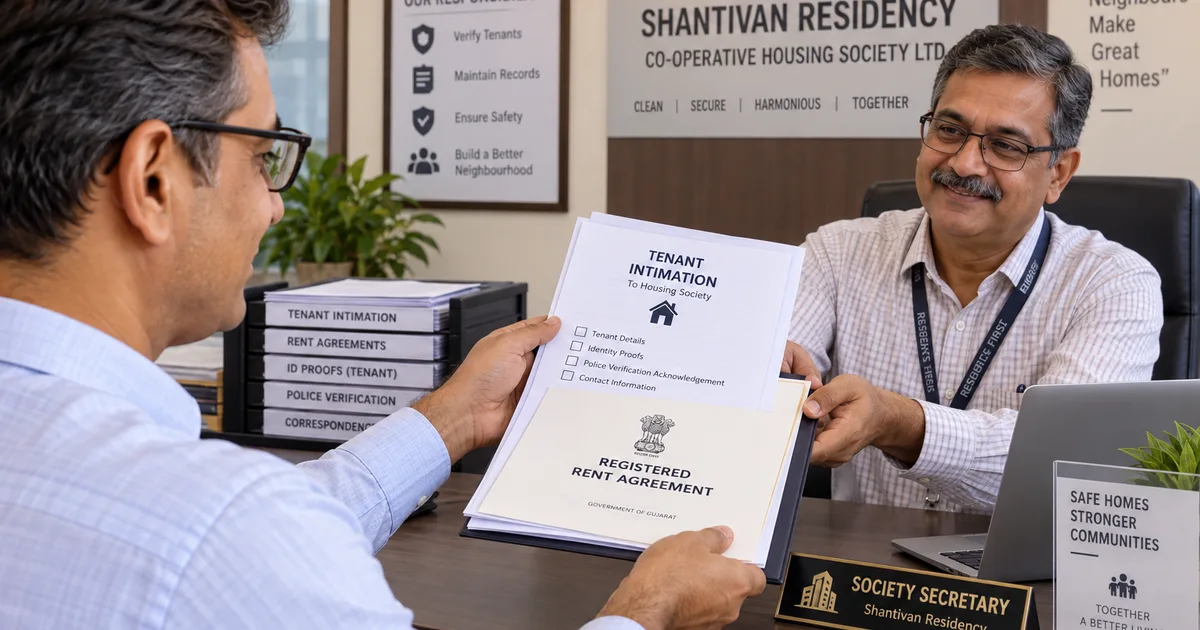
Renting out an apartment or flat in an Indian Cooperative Housing Society (CHS) or Resident Welfare Association (RWA) is an excellent way to earn steady rental income. However, for many flat owners and landlords across cities like Mumbai, Pune, Bengaluru, Delhi NCR, and Hyderabad, navigating housing society rules can feel like an overwhelming administrative obstacle course.
Many flat owners face frustrating challenges when onboarding a new tenant:
- "The society managing committee is demanding a ₹5,000 'NOC Fee' before letting my tenant move in."
- "The RWA is refusing permission because my tenants are single working bachelors."
- "The society office is charging ₹2,000 per month as Non-Occupancy Charges."
- "Security guards blocked my tenant's move-in truck at the gate."
These common friction points raise vital legal questions: Is a formal Housing Society NOC (No Objection Certificate) legally compulsory before renting? What is the statutory limit on Non-Occupancy Charges under state cooperative housing laws? What documents must a landlord submit? What can you do if a society committee illegally rejects your tenant?
In this ultimate 2026 legal and procedural guide, we unpack the truth about Housing Society NOC Rules, Model Bye-Law No. 43, the 10% Non-Occupancy Charges Cap, a 5-Stage Society Clearance Roadmap, legal remedies against RWA harassment, and how property management platforms like RentTenant streamline society intimation letters and tenant gate passes.
Table of Contents
- Is Society NOC Legally Mandatory Before Renting?
- The Truth About Model Bye-Law No. 43 & 8-Day Intimation
- The 10% Non-Occupancy Charges Rule
- Statutory Capping & Calculation Breakup
- The 5-Stage Housing Society Clearance Roadmap
- Stage 1: Execute a Registered Leave & License Agreement
- Stage 2: Complete Online Tenant Police Verification
- Stage 3: Submit Formal 8-Day Written Intimation Letter
- Stage 4: Clear Pending Dues & Pay Statutory 10% NOC Fees
- Stage 5: Obtain Tenant Move-In Gate Pass & ID Badges
- Overcoming Illegal RWA Restrictions & Refusals
- Bachelor Bans, Dietary Restrictions & Registrar Complaints
- Automating Society Clearance with RentTenant
- Frequently Asked Questions (FAQs)
1. Is Society NOC Legally Mandatory Before Renting?
One of the most widespread legal misconceptions among apartment owners is that they must obtain formal "permission" or an NOC from their Housing Society managing committee before leasing their flat.
+-------------------------------------------------------------------+
|               LEGAL TRUTH ABOUT HOUSING SOCIETY NOCs              |
+-------------------------------------------------------------------+
|  STATE MODEL BYE-LAWS (e.g. Maharashtra CHS Bye-Law No. 43)      |
|  - A flat owner DOES NOT require a formal NOC from the society.   |
|  - The flat owner MUST submit a formal WRITTEN INTIMATION LETTER  |
|    to the society 8 days prior to tenant move-in.                |
|  - Must attach copy of registered agreement & police verification.|
+-------------------------------------------------------------------+
The Legal Standing Under State Bye-Laws:
Under State Cooperative Housing Society Bye-Laws (such as Maharashtra CHS Bye-Law No. 43):
- A flat owner DOES NOT require a formal NOC from the society managing committee to rent out their flat.
- The flat owner is only required to submit a Formal Written Intimation Letter to the society 8 days prior to tenant move-in, accompanied by a copy of the Leave & License Agreement and Tenant Police Verification Acknowledgement.
A housing society committee cannot refuse permission or prevent a flat owner from leasing their private property as long as procedural intimation is completed.
2. The 10% Non-Occupancy Charges Rule
When a flat owner rents out their apartment rather than residing in it personally, housing societies are permitted to levy a extra service fee known as a Non-Occupancy Charge.
However, many housing societies illegally charge flat rates of ₹1,000 to ₹5,000 per month. This is strictly illegal under Indian cooperative law.
+-------------------------------------------------------------------+
|            NON-OCCUPANCY CHARGE CALCULATION EXAMPLE               |
+-------------------------------------------------------------------+
|  Society Monthly Maintenance Breakup:                             |
|  - Basic Service Charges: ₹1,000                                  |
|  - Municipal Property Tax: ₹1,500 (Excluded)                      |
|  - Water Charges: ₹500 (Excluded)                                 |
|  - Sinking Fund: ₹300 (Excluded)                                  |
|  ---------------------------------------------------------------  |
|  MAXIMUM PERMISSIBLE NON-OCCUPANCY CHARGE = 10% of ₹1,000 = ₹100  |
+-------------------------------------------------------------------+
Statutory Capping (Government Notifications):
Under state cooperative department circulars (e.g. Govt of Maharashtra notification dated August 9, 2001, upheld by the Bombay High Court):
- 10% Cap: Non-occupancy charges cannot exceed 10% of basic service charges (excluding municipal property taxes, water charges, sinking funds, and insurance).
- Family Exemption: Non-occupancy charges CANNOT be levied at all if the flat is occupied by close family members (spouse, children, parents, siblings, son-in-law, or daughter-in-law).
3. The 5-Stage Housing Society Clearance Roadmap
Follow this 5-stage roadmap to secure smooth society clearance for your tenant:
+-------------------------------------------------------------------+
|             5-STAGE HOUSING SOCIETY CLEARANCE ROADMAP             |
+-------------------------------------------------------------------+
|  STAGE 1: EXECUTE REGISTERED LEAVE & LICENSE AGREEMENT            |
|  - Formal contract specifying tenant details & occupancy tenure.  |
|                                                                   |
|  STAGE 2: COMPLETE ONLINE TENANT POLICE VERIFICATION              |
|  - File tenant details on police portal & obtain receipt.         |
|                                                                   |
|  STAGE 3: SUBMIT FORMAL 8-DAY WRITTEN INTIMATION LETTER           |
|  - Submit intimation letter to RWA Secretary with doc attachments.|
|                                                                   |
|  STAGE 4: CLEAR PENDING MAINTENANCE DUES & PAY 10% NOC            |
|  - Ensure owner maintenance ledger is 100% up to date.            |
|                                                                   |
|  STAGE 5: OBTAIN TENANT MOVE-IN GATE PASS & ID BADGE              |
|  - Receive society gate clearance for tenant move-in truck.       |
+-------------------------------------------------------------------+
Stage 1: Execute a Registered Leave & License Agreement
Execute a formal rental contract specifying tenant names, permanent addresses, employment details, and lease duration.
Stage 2: Complete Online Tenant Police Verification
File your tenant's details on your city's official police portal (e.g., Mumbai Police, Delhi Police, Bengaluru City Police) and obtain a digital Police Verification Acknowledgement Receipt.
Stage 3: Submit Formal 8-Day Written Intimation Letter
Submit a formal written intimation letter to the Housing Society President or Secretary at least 8 days prior to move-in. Attach:
- Copy of the signed/registered Leave & License Agreement.
- Copy of Tenant Police Verification Acknowledgement.
- Tenant Aadhaar/PAN ID copies.
Automate Housing Society Clearances & Tenant Onboarding with RentTenant
Manage housing society compliance effortlessly. Use RentTenant to generate 8-day society intimation letters, store tenant police verification PDFs, calculate 10% non-occupancy fees, and coordinate gate passes.
Stage 4: Clear Pending Dues & Pay Statutory 10% NOC
Ensure all past owner maintenance dues are cleared and pay the statutory 10% Non-Occupancy Charge included in your maintenance bill.
Stage 5: Obtain Tenant Move-In Gate Pass & ID Badges
Receive society security clearance and move-in gate passes to ensure a hassle-free move-in day for your tenant's luggage vehicle.
4. Overcoming Illegal RWA Restrictions & Refusals
If an RWA managing committee attempts to block your tenant illegally (e.g. banning bachelors, enforcing vegetarian-only rules, or demanding illegal NOC fees):
- Submit Written Model Bye-Law Citation: Cite Model Bye-Law No. 43 stating that NOC is not legally required and RWA resolutions cannot override state laws or constitutional rights under Article 21.
- Serve an Advocate's Legal Notice: Have a legal advocate issue a formal notice to the RWA President and Secretary for illegal interference with private property rights.
- File a Petition with the Registrar of Co-operative Societies: File an official complaint under Section 79/91 of the Co-operative Societies Act against the committee for ultra vires actions. The Registrar can issue a direct order penalizing the managing committee.
5. Automating Society Clearance with RentTenant
Managing housing society compliance manually can be time-consuming. RentTenant simplifies society offboarding and tenant clearance for flat owners:
Key RentTenant RWA Features:
- Auto-Generated Society Intimation Letters: Pre-formats 8-day society intimation letters with attached agreement PDFs.
- Police Verification Vault: Stores digital police verification receipts for instant sharing with society managers.
- 10% Non-Occupancy Fee Calculator: Verifies maintenance bills to ensure non-occupancy charges don't exceed the statutory 10% cap.
- Digital Tenant Gate Pass Tracker: Coordinates move-in/move-out clearances digitally with society security.
6. Frequently Asked Questions (FAQs)
Q1. Is a housing society NOC mandatory before renting out a flat in India?
No. Under state Cooperative Housing Society Model Bye-Laws (such as Maharashtra CHS Bye-Law No. 43), a formal NOC is not legally required. Flat owners only need to submit a written intimation letter 8 days prior to move-in.
Q2. What is the maximum non-occupancy charge a housing society can charge?
Non-occupancy charges are legally capped at a maximum of 10% of basic service charges (excluding municipal taxes, water charges, sinking funds, and insurance).
Q3. Can a housing society refuse permission to rent to bachelors or unmarried couples?
No. Housing societies have zero statutory power under Cooperative Societies Acts to dictate a flat owner's tenant choices based on marital status, gender, or dietary habits.
Conclusion
Renting out your apartment should be a smooth, transparent financial venture. By understanding that formal Society NOCs are not legally mandatory, adhering to the 8-Day Intimation Protocol, enforcing the 10% Non-Occupancy Charges Cap, completing tenant police verification, and managing society clearances digitally with RentTenant, flat owners can protect their property rights and maintain harmonious relations with housing society committees.
Ready to streamline transparent, dispute-free rental property management? Explore RentTenant Property Management Software Today

About the Author
Jyostna Deshmukh
Jyostna Deshmukh is a real estate and rental property professional from Maharashtra with over six years of hands-on experience in rental operations and technology-enabled tenant management. Her expertise spans rental properties, hostels, PG accommodation, tenant relations and day-to-day property operations. Through her writing, she shares practical insights into rental challenges, real estate practices and technology-driven property management. She explores how automation can help property owners simplify operations, improve tenant experiences and build more transparent, efficient and scalable rental businesses.