What Fire Safety Rules Must PG Owners Follow in India? Fire NOC, NBC 2016 Norms & Inspection Guide
A comprehensive 2026 fire safety compliance guide for PG owners, hostel managers, and commercial landlords in India. Learn National Building Code (NBC 2016 Part 4) guidelines, Fire NOC application steps, dual evacuation staircases, 30mA RCCB electrical wiring safety, commercial kitchen LPG rules, state-wise NOC threshold matrix, penalties, and RentTenant fire safety vault.
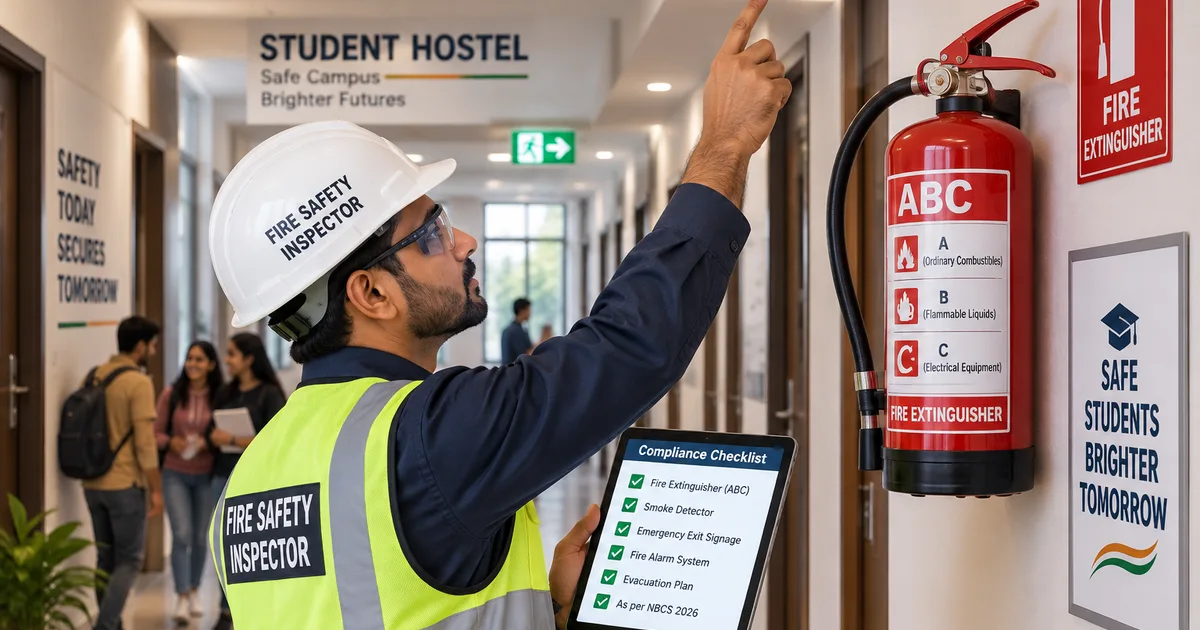
Paying Guest (PG) accommodations, student hostels, and co-living facilities across Indian cities host millions of young students and working professionals. Because these multi-occupancy buildings combine high resident density, commercial kitchens, heavy electrical AC loads, and shared corridors, life safety and fire prevention must be the top priority for every property owner.
Tragic fire outbreaks in commercial student hubs have prompted municipal corporations and Fire Departments across India to enforce strict fire safety compliance. Operating a PG without proper fire suppression systems or a valid Fire No Objection Certificate (Fire NOC) can lead to immediate building sealing, power disconnection, and severe criminal prosecution.
What are the mandatory rules under the National Building Code (NBC 2016 Part 4)? When is a Fire NOC mandatory for a PG building? Why are 30mA RCCB circuit breakers essential for preventing electrical fires? What are the state-wise renewal rules and penalties?
In this comprehensive 2026 legal and technical guide, we unpack the 7 Core Fire Safety Rules Every PG Owner Must Follow, state-wise Fire NOC height thresholds, electrical short-circuit protection, commercial kitchen LPG safety, and how modern property management platforms like RentTenant empower PG operators to digitize safety audit logs and provide 1-click Emergency SOS Alerts for residents.
Table of Contents
- Why Fire Safety Compliance is Non-Negotiable for Indian PGs
- Understanding Life Safety Risks in Multi-Occupancy Housing
- The NBC 2016 Part 4 Life Safety Framework
- National Standards for Fire Prevention & Evacuation
- The 7 Core Fire Safety Rules Every PG Owner Must Follow
-
- Obtain a Valid Fire No Objection Certificate (Fire NOC)
-
- Ensure Dual Evacuation Staircases & Unobstructed Exits
-
- Install Mandatory Fire Extinguishers & Suppression Systems
-
- Mandate 30mA RCCB Electrical Short-Circuit Protection
-
- Commercial Kitchen & LPG Cylinder Safety Rules
-
- Photoluminescent Emergency Exit Signage & Lighting
-
- Conduct Bi-Annual Staff Training & Evacuation Drills
-
- State-Wise Fire NOC & Height Threshold Matrix
- Rules for Delhi NCR, Karnataka, Maharashtra, UP & Tamil Nadu
- Penalties for Non-Compliance under Indian Law
- Building Sealing & IPC 304 / BNS 105 Culpable Homicide Charges
- Automating Fire Safety Management with RentTenant
- Frequently Asked Questions (FAQs)
1. Why Fire Safety Compliance is Non-Negotiable for Indian PGs
Student hostels and PGs are classified as high-density residential facilities. Unlike single-family homes, PGs host dozens of residents sharing single staircases, running multiple 1.5-ton air conditioners simultaneously, and using commercial kitchens.
|            NBC 2016 PART 4 MANDATORY FIRE SAFETY MATRIX           |
|  1. FIRE NOC OBTAINMENT   -> Mandatory for buildings >9m to 15m   |
|                              or PGs with high resident density.   |
|  2. MEANS OF EGRESS       -> Minimum 2 unblocked staircases;      |
|                              terrace exit doors must stay unlocked|
|  3. EXTINGUISHERS & ALARMS-> 1 ABC 4kg Extinguisher per floor;    |
|                              CO2 at electrical panels; smoke alarm|
|  4. ELECTRICAL SAFETY     -> 30mA RCCB/ELCB breakers on meters;   |
|                              certified electrical load audit.     |
|  5. STAFF & DRILL LOGS    -> Bi-annual mock drills & warden train.|
A minor electrical short-circuit or kitchen grease fire can escalate into a severe hazard within minutes if fire extinguishers, smoke alarms, or clear evacuation routes are missing.
2. The NBC 2016 Part 4 Life Safety Framework
The National Building Code of India (NBC 2016 Part 4: Fire and Life Safety) sets the national technical benchmarks for fire prevention, compartmentation, egress design, and fire suppression systems.
State governments and municipal corporations integrate NBC 2016 guidelines into local building bye-laws (e.g., Delhi Fire Services Act 2007, Maharashtra Fire Prevention Act 2006, Karnataka Fire Force Rules).
3. The 7 Core Fire Safety Rules Every PG Owner Must Follow
Every PG operator and hostel owner in India must comply with these seven core fire safety rules:
1. Obtain a Valid Fire No Objection Certificate (Fire NOC)
- Mandatory Thresholds: Fire NOCs are legally required for PGs operating in buildings exceeding state height thresholds (typically 9 meters in Delhi or 15 meters in Karnataka/Maharashtra) or hosting high occupant densities (e.g. 20+ occupants or PGs above 3 upper floors).
- Renewal: Fire NOCs are valid for 1 to 3 years and must be renewed prior to expiration.
2. Ensure Dual Evacuation Staircases & Unobstructed Exits
- Staircase Clear Width: Staircases must maintain a minimum clear width of 1.25 to 1.5 meters to allow simultaneous downward evacuation.
- Secondary Emergency Exit: High-density PGs must provide a secondary external fire escape ladder or steel emergency staircase.
- Rooftop Access: Terrace doors must never be padlocked. They must remain accessible or fitted with panic bars for upward escape during ground-floor fires.
3. Install Mandatory Fire Extinguishers & Suppression Systems
- ABC Powder Extinguishers: At least one 4kg/6kg ABC Powder Extinguisher per floor placed near staircases and corridors.
- CO2 Extinguishers: Placed directly adjacent to main electrical distribution panels and sub-meter boards.
- Hose Reels & Water Tanks: High-rise PGs must maintain a dedicated overhead fire water storage tank (min 5,000L to 10,000L) connected to a booster fire pump and hose reels.
4. Mandate 30mA RCCB Electrical Short-Circuit Protection
Over 75% of PG fires originate from electrical short circuits caused by overloaded wiring carrying multiple AC loads.
- 30mA RCCB Breakers: Every main meter board must feature a 30mA Residual Current Circuit Breaker (RCCB/ELCB) that trips power within 30 milliseconds during current leakage.
- Annual Load Audit: Conduct an annual electrical safety audit through a certified electrical contractor.
5. Commercial Kitchen & LPG Cylinder Safety Rules
- Kitchens must feature fire-resistant wall barriers and gas leak detectors.
- LPG Storage: Commercial LPG cylinders must be stored in well-ventilated ground-floor enclosures. LPG cylinders are strictly prohibited inside student bedrooms.
6. Photoluminescent Emergency Exit Signage & Lighting
Install self-glowing, photoluminescent "EXIT" signs and emergency battery backup lights in corridors and stairwells to guide residents during power outages.
7. Conduct Bi-Annual Staff Training & Evacuation Drills
PG operators must conduct mock evacuation drills every 6 months and train all wardens, kitchen staff, and security guards on operating fire extinguishers.
4. State-Wise Fire NOC & Height Threshold Matrix
Fire NOC requirements vary by state jurisdiction:
| Delhi NCR | Delhi Fire Services (DFS) | >9 meters height / High Density | 3 Years | | Karnataka | Karnataka Fire Force (KSFES) | >15 meters height / Commercial | 2 Years | | Maharashtra | Maharashtra Fire Services | All Commercial / PG Boarding | Form B (Every 6 Months)| | Tamil Nadu | Tamil Nadu Fire & Rescue | Public & Boarding Buildings | 1 Year | | Uttar Pradesh | UP Fire Prevention Services | >15 meters height / Commercial | 3 Years |
Manage Fire Safety & Property Compliance Effortlessly with RentTenant
Build 100% tenant and parent trust. Use RentTenant to store Fire NOC PDFs, electrical audit logs, and equipment maintenance dates, receive renewal alerts, and equip residents with 1-click Emergency SOS alerts.
5. Penalties for Non-Compliance under Indian Law
Operating an uncertified PG or ignoring fire safety warnings carries severe legal liabilities:
|               FIRE SAFETY PENALTY ENFORCEMENT                     |
|  VIOLATION               |  STATUTORY PENALTY ENFORCEMENT         |
|  - Absence of Fire NOC / |  Immediate Sealing of PG Premises &    |
|    Safety Systems        |  Power/Water Disconnection Orders      |
|  - Fire Outbreak Causing |  IPC Section 304 / BNS Section 105     |
|    Loss of Life          |  (Up to 10 Years Imprisonment)        |
- Premises Sealing: Fire Officers and Municipal Authorities can issue immediate building sealing orders.
- IPC Section 304 / BNS Section 105: Culpable Homicide Not Amounting to Murder — Applied when an owner knowingly operates a PG without fire safety equipment and a fire accident results in fatalities. Carries up to 10 years imprisonment.
6. Automating Fire Safety Management with RentTenant
Managing fire safety compliance logs manually can lead to missed maintenance dates. RentTenant simplifies fire safety compliance for PG operators:
Key RentTenant Fire Safety Features:
- Digital Fire Safety Vault: Store Fire NOC PDFs, electrical audit reports, equipment refilling certificates, and mock drill logs in a single compliance dashboard.
- Automated Equipment Refilling Alerts: Sends automated alerts before Fire NOC expiry or extinguisher refilling dates.
- Display Safety Compliance Certificate: Displays verified fire safety credentials on your digital property portal to build better documented parent and student trust.
- 1-Click Resident Emergency SOS Alert System: Equips residents with an in-app Emergency SOS button notifying wardens, security, and local fire stations instantly.
7. Frequently Asked Questions (FAQs)
Q1. Is a Fire NOC mandatory for running a PG or hostel in India?
Yes. A Fire NOC is mandatory for PGs operating in buildings exceeding state height caps (typically 9m to 15m) or hosting high occupant densities (e.g. 20+ occupants or PGs above 3 upper floors).
Q2. What fire extinguishers are required in a PG building under NBC 2016?
Every floor must have at least one 4kg/6kg ABC Powder Extinguisher near staircases, plus CO2 extinguishers installed directly adjacent to main electrical distribution panels.
Q3. How often must a Fire NOC be renewed for a commercial PG?
Depending on state regulations, Fire NOCs are valid for 1 to 3 years. In Maharashtra, PG owners must also submit Form B safety certificates every 6 months.
Conclusion
Fire safety is an uncompromisable foundation of running a responsible, legal PG business in India. By securing a Fire NOC, installing dual evacuation staircases, mandating 30mA RCCB electrical short-circuit protection, conducting bi-annual mock drills, and digitizing compliance records with RentTenant, PG owners can protect human lives, prevent municipal sealing drives, and build a trusted, tech-enabled property.
Ready to manage a safe, compliant, and tech-enabled PG property? Explore RentTenant Property Management Software Today
Review note: General information only. Legal, safety and regulatory requirements vary by state and local authority; verify the current official source and obtain professional advice before relying on a material decision.
State-wise fire-safety applicability
Fire NOC, occupancy limits, inspections and required drawings are controlled by the local authority. Delhi, Maharashtra, Gujarat and other states can use different portals, forms and thresholds. Confirm the property's municipal ward, use classification and current fire-department checklist before operating.
Official source authority
Use the linked primary portals above as the current reference. State portals and notifications control where they differ from general guidance.
Practical checklist
| Step | Owner/tenant action | Evidence to keep |
|---|---|---|
| 1 | Confirm the applicable state, city and agreement terms | Current official URL and signed agreement |
| 2 | Record the issue with date, people and exact amount | Photos, invoices, messages and dated log |
| 3 | Send a clear written request or notice | Email/WhatsApp export and delivery proof |
| 4 | Escalate only through the relevant authority or forum | Complaint number and acknowledgement |
What to do next
- Save the agreement, identity/occupancy records and all dated evidence.
- Verify the latest state or municipal rule before taking action.
- Ask the counterparty for an itemised response and a reasonable timeline.
- Obtain advocate, CA, fire-safety or food-safety advice where the decision is material.
Worked example: 30-bed PG
For a 30-bed property, map each sleeping room, common area, exit route, extinguisher location and occupancy limit. A fire checklist is not approval: the local authority may require drawings, inspection, alarms, emergency lighting and a Fire NOC based on use and area.

About the Author
Jyostna Deshmukh
Jyostna Deshmukh is a real estate and rental property professional from Maharashtra with over six years of hands-on experience in rental operations and technology-enabled tenant management. Her expertise spans rental properties, hostels, PG accommodation, tenant relations and day-to-day property operations. Through her writing, she shares practical insights into rental challenges, real estate practices and technology-driven property management. She explores how automation can help property owners simplify operations, improve tenant experiences and build more transparent, efficient and scalable rental businesses.